What's the difference between kickboxing and Muay Thai?
Muay Thai allows eight striking weapons: two fists, two elbows, two knees and two shins. Most kickboxing rules allow four, the fists and the legs, and ban elbows outright. Muay Thai also permits sustained clinch fighting, where fighters grip each other's head and arms while standing. Kickboxing breaks that clinch within seconds.
That is the honest short answer. The differences between Muay Thai and kickboxing get slippery because Muay Thai is one reasonably consistent combat sport, while kickboxing is an umbrella covering several rulesets that disagree with each other. So the real question is rarely Muay Thai or kickboxing. It is usually which kickboxing.
Muay Thai vs kickboxing: eight limbs against four
Muay Thai is the national sport of Thailand and is often called the art of eight limbs. You will see it written both ways online, the art of eight limbs and the art of 8 limbs, and both mean the same: two fists, two elbows, two knees and two legs, usually striking with the shin rather than the foot.
Kickboxing is normally described as a four-point striking system. Two fists, two legs. That shorthand is useful but not complete, because some kickboxing rules do allow knee strikes.
Neither is a grappling art. Both are stand-up fighting styles, and neither takes the fight to the floor to grapple.
Is Muay Thai kickboxing? Why the word gets slippery
Muay Thai is sometimes called Thai boxing, and plenty of Muay Thai gyms in Canada advertise as kickboxing because that is the word people search. So yes, in loose conversation Muay Thai gets called kickboxing. Under a rulebook, no, they are separate martial arts.
Here is where the word actually splits:
- American kickboxing, or full contact. Punches and kicks above the waist only. No leg kicks, no knees, no elbows, no clinch work.
- K-1 kickboxing and Dutch kickboxing. Punches, kicks and low kicks, plus knees. K-1 rules typically allow one knee from a brief hold, then a break.
- Cardio kickboxing. A fitness product, not a rulebook. Bags, pads and combinations set to music, with no scoring, no opponent and often no contact at all.
- Muay Thai. Punches, kicks, knees, elbows and a full clinch.
None of that makes any of them fake. It just means the sign on the door tells you less than you think. Ask a room which kickboxing rules it teaches and the fog lifts immediately.
The clinch is the biggest gap in the rules
A clinch is standing grappling: you control your partner's head, neck or arms at close range while both of you stay on your feet.
In Muay Thai the clinch is a whole phase of the fight. Fighters work for head and posture control, land knee strikes to the body and legs, turn each other off balance and dump each other to the canvas. Under IFMA's international rules the referee only breaks it when it goes inactive or illegal, not on contact.
Kickboxing rules treat the clinch as an interruption. WAKO's K-1 rules allow a fighter to hold the neck or shoulders for a single knee, then require a release, with the active clinch measured in seconds. Full contact rules ban intentional clinching altogether.
Those differences in rules reshape everything: the stance you stand in, what you do when someone closes distance and how much of your training is spent learning to control a body instead of hit one.
Elbows and knees: what each ruleset allows
| Weapon | Muay Thai | K-1 or Dutch kickboxing | American full contact |
|---|---|---|---|
| Punches | Legal | Legal | Legal |
| Kicks to the body and head | Legal | Legal | Legal |
| Low kicks to the thigh | Legal | Legal | Not allowed |
| Knee strikes | Legal | Legal, usually limited | Not allowed |
| Elbow strikes | Legal for senior competitors | Not allowed | Not allowed |
| Extended clinch | Legal and central | Seconds only | Not allowed |
| Catching a kick | Generally legal | Generally not allowed | Not allowed |
The use of elbows and knees is the sharpest dividing line here. No mainstream kickboxing ruleset permits elbow strikes at all, and knees swing from fully legal to banned depending on the rules. Youth and amateur Muay Thai divisions restrict elbows and head knees too, so a beginner is not learning them on night one either.
How Muay Thai scoring differs from kickboxing rules
Muay Thai scoring rewards effect over volume. Judges look at clean, powerful strikes, balance, damage, dominance and control of the ring. A Muay Thai fighter who lands three clean shots and stays composed can beat one who throws thirty light ones. Kicks to the arms that get blocked generally do not score at all, and a kick that lands but leaves you stumbling can lose you the exchange.
Kickboxing matches reward what you can see more directly: clean volume, combinations, forward pressure and continuous activity. A tight combo of punches and kicks reads well to a kickboxing judge.
Neither system ignores the other's priority. Professional Muay Thai still counts output and kickboxers still get credit for damage, but the weighting is why the two look so different on video.
What a beginner class actually feels like
Nobody walks in and clinches on day one. Here is what the first weeks of Muay Thai training genuinely look like, and where kickboxing training differs.
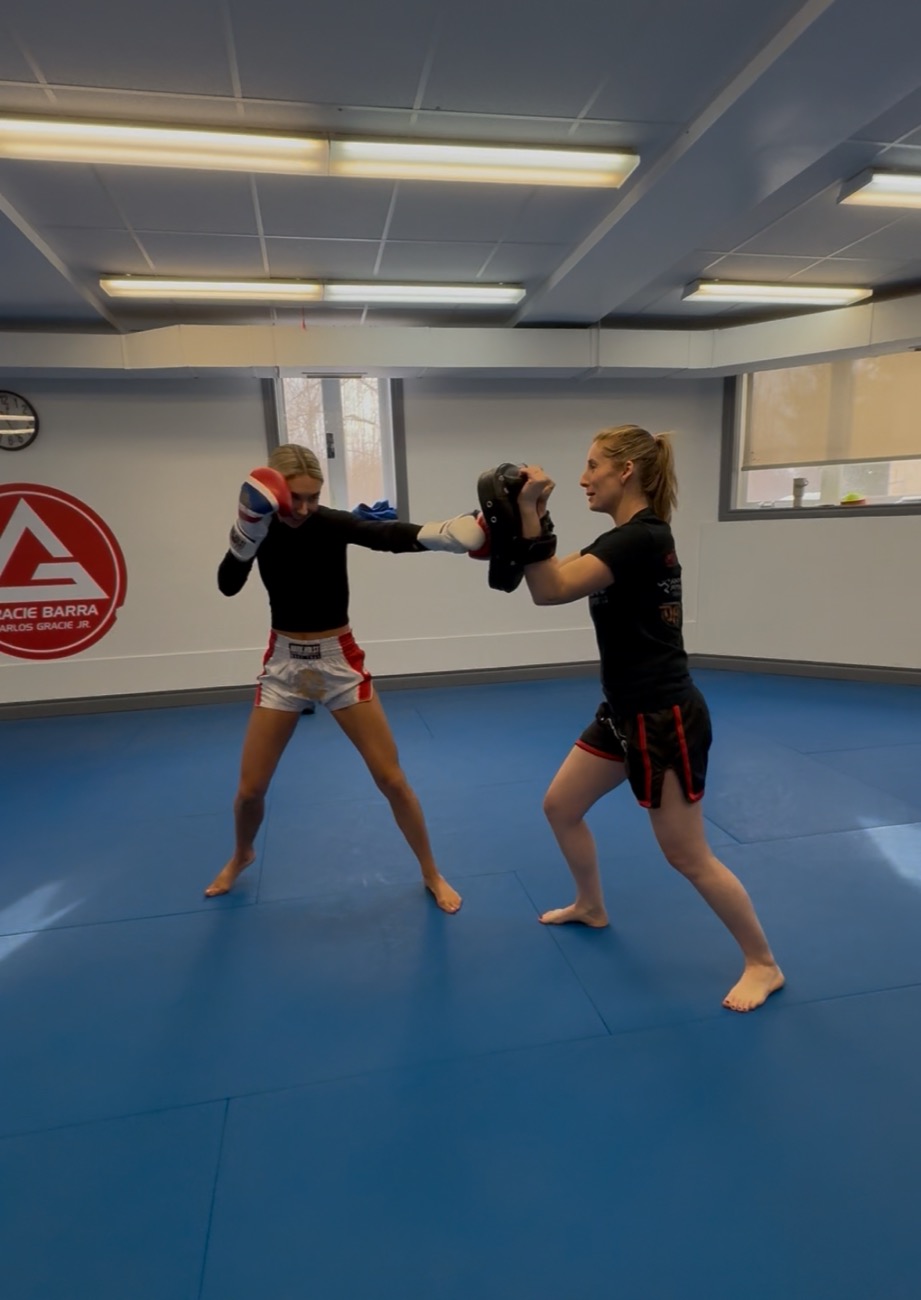
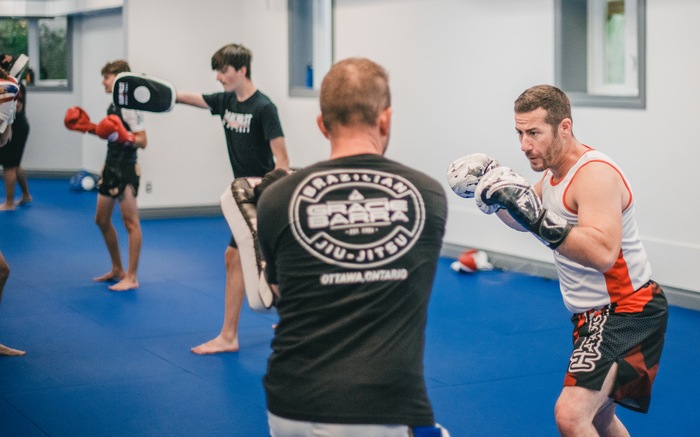
You will spend most of a beginner class in boxing gloves on pads, which are the padded targets a partner holds for you, and on the heavy bag, learning to throw punches and kicks that do not wreck your own balance. Footwork comes early. Shin conditioning is not a separate ritual, it is the ordinary result of kicking pads a few times a week, and yes, your lower shin will be tender for a while.
A kickboxing room drawing on western boxing and Dutch kickboxing methods will usually put you in a more bladed stance, with more head movement and more combination punching. A traditional Muay Thai room keeps you squarer and more upright so you can check low kicks, teep and enter the clinch. A teep is the straight push kick used to hold someone at distance.
We keep pad work and sparring in separate classes. Pad work runs at 7:15 PM Monday through Thursday and 11:15 AM Saturday. Drills and sparring run at 8:15 PM Monday through Thursday and noon Saturday. You choose when, and if, you spar.
Should you pick Muay Thai or kickboxing?
Ask yourself what you pictured when you typed the word.
If you pictured a workout, music, a bag and no one hitting back, you want a cardio class, and there is nothing wrong with that. If you pictured combinations, hand speed and a boxing rhythm with kicks added, kickboxing or K-1 kickboxing is a fair match. If you pictured shins, knee strikes, the clinch and a heavier stand-up fighting style you can carry into mixed martial arts later, that is Muay Thai.
For MMA, both feed in. Muay Thai and kickboxing each hand you a real striking system, and fighters routinely borrow kicks and punches from both.
Muay Thai in Manotick and south Ottawa
People searching muay thai kickboxing ottawa are usually after one room that will not make them decide before they have tried anything. Our Muay Thai program at 5700 Longshadow St runs weeknights and Saturdays, a short drive from Riverside South, Greely and Findlay Creek, with parking at the door.
Kids Muay Thai runs Monday through Thursday at 6:30 PM. There is also a women's only Muay Thai class Sunday at 11:15 AM, for anyone who would rather not be the only woman in the room on a first night. The full class schedule and the Ottawa Muay Thai page have the rest.
Dan R, a Riverside South dad in his late thirties, told us he had searched kickboxing for a year before he booked anything. He had done a cardio class years earlier and assumed that was what he would get. What surprised him most was how much of the first month was footwork and pad holding rather than getting hit. He now trains twice a week and still describes it to friends as kickboxing, because it is easier than explaining.
The questions people actually ask.
Is it better to do kickboxing or Muay Thai?+
Neither is better, they reward different things. Muay Thai gives you elbows, knees and clinch work, while kickboxing usually gives you faster combinations and a boxing-heavy rhythm. Pick the one whose training you will actually keep showing up for.
Can a kickboxer beat a Muay Thai fighter?+
Yes, and the reverse happens just as often. Under kickboxing rules a Muay Thai fighter loses the clinch and elbows, and under Muay Thai rules a kickboxer faces weapons they do not train. The ruleset matters more than the label.
Can you knee or clinch in kickboxing?+
It depends entirely on the ruleset. K-1 kickboxing allows knees and a very brief hold, while American full contact bans knees and intentional clinching outright. Always ask the room which rules it trains under.
Is Muay Thai effective for self-defence?+
It builds real composure under physical pressure, which is the honest benefit. No martial art can promise an outcome in a real situation, because those are unpredictable and can involve more than one person. Avoiding the situation is always the better result.