How does BJJ tournament scoring work?
BJJ tournament scoring works on positional control. A referee awards 2 points for a takedown or a sweep, 3 points for a guard pass, and 4 points for reaching mount or back control, once each position is held for 3 seconds. Advantages break ties. A submission ends the match, whatever the score is.
The BJJ point system: what each position is worth
Almost every gi tournament your child will enter in Ottawa this fall runs on the IBJJF scoring system, so that is the one to learn. It is a point system built around getting on top and staying there. The BJJ scoring system rewards positional control over flashy movement, which is why matches can look quiet and still be scoring heavily.
Here is what each dominant position is worth, in gi and no-gi alike:
| Action | Points | What actually happens |
|---|---|---|
| Takedown | 2 points | A throw or trip from standing that lands the opponent on their back, side or seated with the top player in control |
| Sweep | 2 points | From guard or half guard, the bottom player reverses to the top position |
| Guard pass | 3 points | The top player gets past the opponent's legs into side control |
| Knee on belly | 2 points | One knee on the opponent's torso, other foot on the ground, facing their head |
| Mount | 4 points | Sitting astride the opponent's torso, both knees or a knee and a foot on the ground |
| Back control | 4 points | Behind the opponent with both heels hooked inside their thighs |
Two rules stitch the whole scoring system together. First, the position has to be stabilized for 3 seconds before the referee raises fingers and points are awarded. A pass that flashes through side control and gets scrambled out of does not score. Second, positions do not stack. If you take someone down and then pass to side control, you get 2 points for the takedown and 3 points for the guard pass, but not extra credit for arriving there.
What the referee actually watches
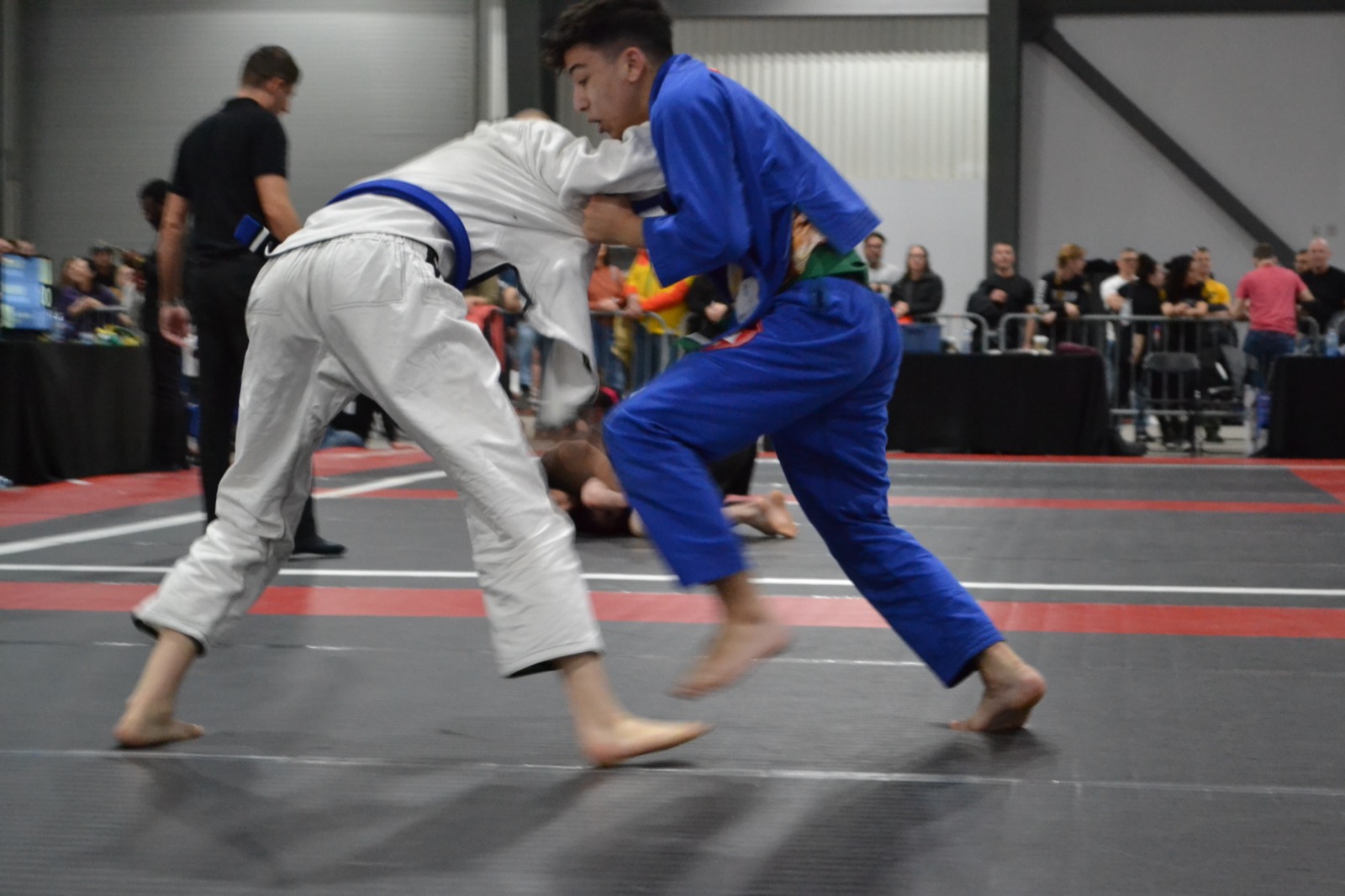
The referee is watching for two things: control and time. Control means the top player is not being reversed and the bottom player is not framing out. Time means those 3 seconds of stillness. When both are met, the referee's hand goes up, fingers spread, and the table changes the score.
Takedowns also need one small thing more. You get 2 points for a takedown only if you follow your opponent down and land on top; a scramble that ends with the other person on top erases the attempt.
Advantages: the near-miss score that decides tight matches
An advantage is a near-score. If you almost passed the guard but could not hold side control for 3 seconds, that is an advantage. If you nearly swept but they scrambled back to top position, that is an advantage. A strong submission attempt that made the opponent defend hard also earns one. Advantage points do not add to your score line. They only matter when the point score is tied at the end of the match, and then whoever has more advantages wins.
This is the piece most first-time parents miss. Your kid can lose a match with a bigger point score because of one clean advantage from the other side. That is not the referee playing favourites; it is the tiebreaker doing its job.
Penalties, stalling and disqualification
The other side of scoring is what you lose. The referee can call a penalty for stalling, for running out of bounds, or for grabbing the fingers or toes. Two penalties in a match give the opponent an advantage. Four penalties give them negative points counted against you and end the match.
Illegal techniques vary by age and belt. Younger kids at IBJJF events cannot use leg locks, and white belts cannot use certain neck cranks. Doing one earns a disqualification, no matter what the score is. The good news is that a kids coach walks a new competitor through this in the weeks leading up. Nobody gets ambushed by the rulebook on the day.
How long a match lasts and what the day looks like
Match length depends on age and belt in the IBJJF bjj rules. As a spectator, this is what to budget:
- Kids and juvenile: 5 minutes
- Adult white belt: 5 minutes
- Adult blue belt: 6 minutes
- Adult purple belt: 7 minutes
- Adult brown belt: 8 minutes
- Adult black belt: 10 minutes
Divisions are broken up by age, belt, weight and gender, and then each division runs as a bracket. A kid in a smaller division may fight two matches. A kid in a bigger division may fight five before the medal round. Between matches, expect long, quiet stretches of waiting. That is normal.
Kids compete in the gi for most local events; no-gi kids divisions are less common but do show up in the Ottawa fall calendar. If your child is registered for both, the day gets longer, not harder.
Reading the scoreboard mat-side
The scoreboard runs simple. Two names, two colours (red or blue, based on the gi tag pinned that morning), and three numbers each: points, advantages, penalties. A submission attempt does not change the numbers, only a completed submission does, and when that happens the match ends flat.
The referee calls positions with quick hand signals: a raised fist for passing the guard, a flat palm for a takedown, three fingers for mount, four for back control. You do not need to read every signal. Watch the scoreboard, and watch the referee's fingers when the crowd reacts.
The warm-up area, the coach corner and your job as a parent
Behind the mats is a warm-up area, usually a stretch of mat or floor mats where competitors drill takedowns, sweeps and simple guard pass movements to keep their bodies warm. A coach or teammate holds pads, holds a partner in closed guard for a couple of minutes, watches for the call to the mat.
Your job as a parent is quieter than you think. Get there early, find your kid's mat number, find the water and the bathroom, and sit close enough that they can see you between matches. Cheering is fine. Coaching from the stands is not. Referees will politely shut it down, and it rattles the kid more than it helps.
The Ottawa tournament calendar this fall
The big local event this fall is the Ontario Brazilian Jiu Jitsu Championship, on Saturday 7 November 2026 at Carleton University, about a 25 minute drive from Manotick. It pulls kids and adults from across the province and uses IBJJF-style scoring, so everything above applies.
Registration closes on 1 November, weight is checked the morning of, and the day usually starts before 9 AM. Check the event bulletin for your division; match times can vary slightly by organizer.
For a room-side view of what training toward that event looks like at our academy, our kids BJJ program and adult BJJ program pages have the current weekly schedule. Coach Panda Dave and the coaching team walk newer competitors through the day one step at a time. You can also see who is on the mats in our instructors and what is coming up on our news and events page.
“They have been competing for the last year and their technique and love for the sport has grown far beyond what we ever expected when we first signed them up just hoping for some exercise and discipline.”
Noura Khair, Google review, March 2026
Questions parents ask about BJJ tournaments
How does the BJJ tournament scoring system work?+
BJJ tournament scoring works on positional control under IBJJF bjj rules. A referee awards 2 points for a takedown, sweep or knee on belly; 3 points for a guard pass; and 4 points for mount or back control, once each position is held for 3 seconds. A submission ends the match.
How many points is mount in BJJ?+
Mount is 4 points in the IBJJF bjj scoring system. To score, the top player sits astride the opponent's torso, with knees or a knee and a foot on the ground, and holds the dominant position for 3 seconds. Back control is also worth 4 points.
What are advantages in BJJ scoring?+
An advantage is a near-score. If a competitor almost passes the guard, almost sweeps, or forces a real defensive reaction with a submission attempt but cannot finish it, the referee gives them an advantage. Advantage points do not add to the score line and only decide the match when points are tied.
What should I bring to my kid's first BJJ tournament?+
A packed gi, a water bottle, snacks that do not weigh a stomach down, layers to sit in a cold arena for hours, and their coach's number saved on your phone. That is enough. Everything else is on site.
Can my child compete in both gi and no-gi divisions?+
Yes. Many Ottawa events run gi and no-gi divisions on the same day, and kids often register for both. Ask a coach first; competing in two divisions doubles the match count and can wear a younger kid out.