Do beginners spar in Muay Thai?
No. Beginners do not spar in Muay Thai on day one. A first Muay Thai class is footwork, shadow work, bag work and pad work with a coach. At a well-run academy, new students train fundamentals for weeks or months before any light technical sparring, and contact sparring stays optional after that.
What a beginner Muay Thai class is made of
It is a skills lesson, not a fight.
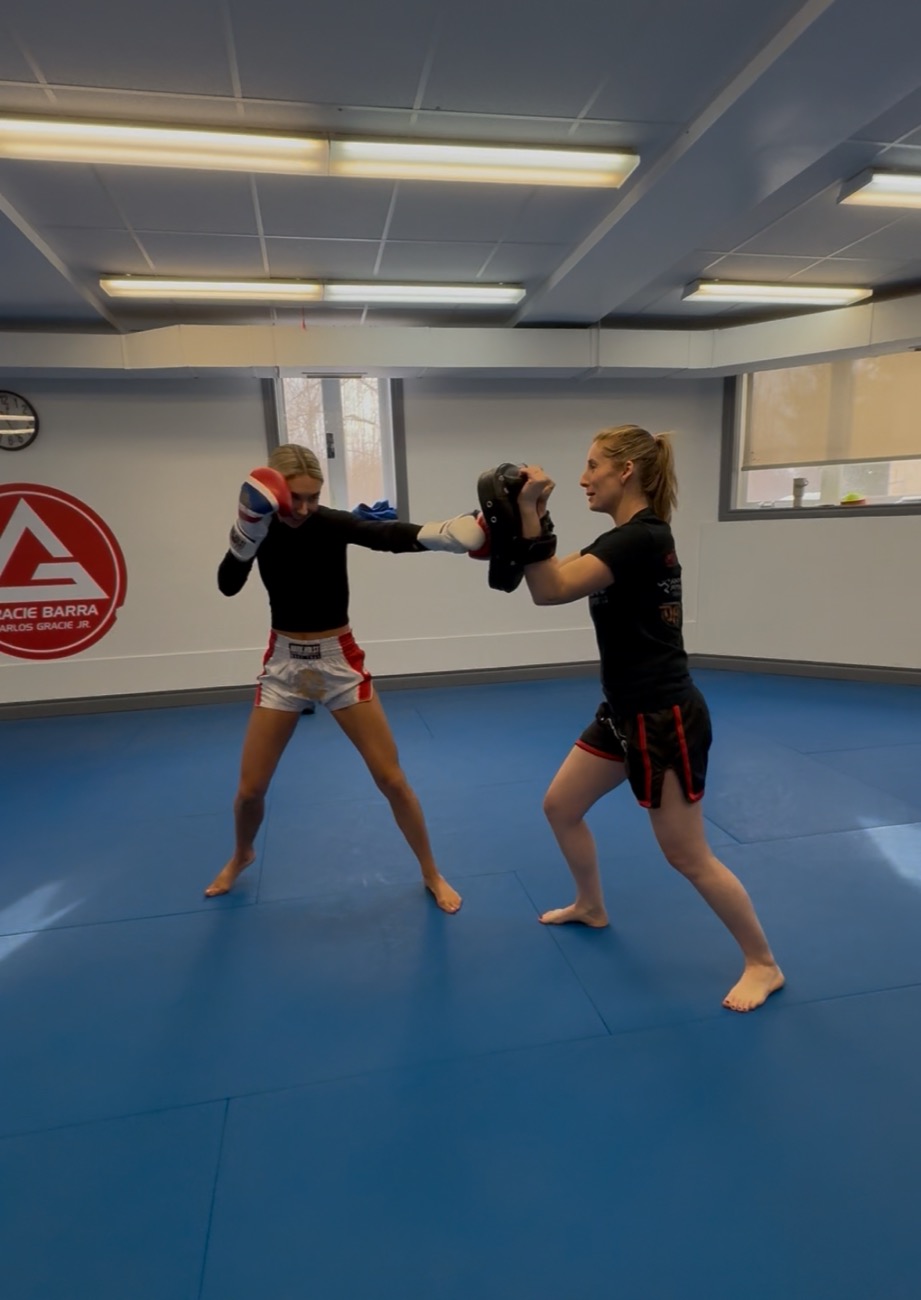
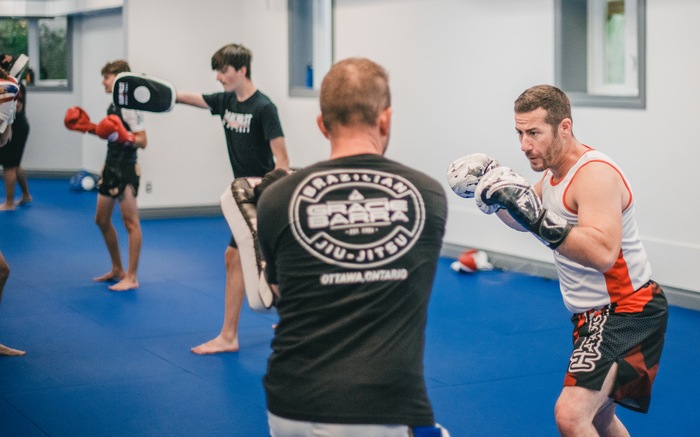
You warm up, then shadow box, which means throwing punches and kicks at the air while a coach fixes your stance, your guard and your footwork. Then comes technique: the jab, the round kick, the teep and how to check a low kick with your shin. You pair off to drill, holding pads for a partner and then swapping, and most sessions finish on the heavy bag.
Notice what is absent. Every strike you throw on your first day lands on a bag or on a pad somebody is deliberately holding still for you. Nobody is throwing back.
Will I get hit in my first Muay Thai class?
You will feel impact, which is not the same as being hit. Holding pads means absorbing a partner's kicks through the leather, and your own shins will find the heavy bag more than once.
What you will not get in a properly run beginner session is another person freely striking at your head while you try to defend yourself. That is sparring, and it is a separate activity you opt into later. Beginners who get hurt in a first class have nearly always been dropped into free exchanges by a room that mistook that for toughness. It is simply unsafe.
How long until you start sparring in Muay Thai?
There is no single number, and any coach who gives you one before watching you train is guessing.
Across well-run academies the common range runs from roughly two to six months of consistent work before a beginner is cleared for light sparring. Some structured programs clear suitable students after an eight-week course. Conservative rooms wait six to twelve months, especially for beginners with no athletic background, and plenty of people train for years without ever taking a hard round. Muay Thai does not use a belt system the way BJJ does, so being ready to spar is a coach's judgment rather than a rank you are handed.
What a coach is watching for is concrete:
- Can you hold a stance and keep your hands up when tired?
- Can you control the power of your own knee or kick and stop a technique halfway?
- Can you take an instruction mid-round and change what you are doing?
- Do you breathe when the pace lifts, or do you panic and swing?
That last one is the real gate. A beginner who cannot yet regulate their own intensity is a hazard to a partner as much as to themselves.
Light technical sparring, hard sparring and what a hobbyist needs
Most people who fear sparring are picturing the wrong version of it.
Light technical sparring is live and unscripted, but both partners deliberately pull their strikes and work at roughly 20 to 30 percent of fight power. The goal is distance, timing and defence. It often starts narrower still: body only, jab only, or one person attacking while the other purely defends.
Hard sparring is realistic pace and real impact. It belongs to people preparing to compete in boxing or Muay Thai or MMA, and even then in small doses. A hobbyist training two nights a week never needs to spar hard to get better. In Thailand, where the sport grew up, a fighter's daily work is pads, bags and clinch rather than constant hard rounds.
The Muay Thai clinch is the close-range position where you control a partner's head and arms. It is where the art starts to grapple, and beginners often find it the least frightening part.
Muay Thai sparring tips for your first spar
The first time you spar, a trusted partner matters more than any technique. A few things also help:
- Ask your sparring partner for a target intensity out loud before the round starts.
- Keep it low-power and go for one clean technique rather than five rushed ones.
- Breathe. Holding your breath is what turns a light round into a panic.
- Treat the person opposite you as a partner rather than an opponent, and say so at once if the pace climbs past what you agreed. Good etiquette is normal, not rude.
Is Muay Thai dangerous for beginners?
It is a contact sport, so no honest coach will claim the risk is zero. What we can tell you is what month one actually looks like.
The real complaints are dull: sore shins from the heavy bag, a bruised forearm from holding pads badly, tight hips and blisters from pivoting barefoot. Ordinary soreness for a day or two is normal. Sharp pinpoint bone pain, swelling that worsens or pain at rest is not, and it means stop and get it assessed. Most beginner injury comes from doing too much too soon, not from contact.
Head contact deserves a straight answer. The Association of Ringside Physicians advises minimizing head shots in training and using properly padded gloves, and its position is that headgear reduces cuts but is not proven to prevent concussion. A mouthguard is required for any sparring, along with shin guards. Research on customary sparring found measurable short-term changes in memory and motor control after only three three-minute rounds, which is exactly why a beginner has no business doing volume head work. Headache, dizziness or nausea means you stop for the day and see a physician.
None of that argues against training. It argues for training somewhere that gates sparring as a supervised skill.
What it means when a gym spars beginners hard right away
This tells you more about a place than its marketing does. If a gym drops a first-timer into a hard round to see how they cope, you have learned three things. Nobody is supervising the room, which lets the most reckless student set the pace. The experienced students have not been taught etiquette. And the place is built around the few athletes who might compete, at the expense of everyone else. Ask the question directly on your first visit, and treat a vague answer as an answer.
How a coach paces sparring at Gracie Barra Manotick
Our timetable settles this before anyone has to ask. Sparring is not buried inside the beginner class. It has its own slot.
Muay Thai Pad Work runs Monday through Thursday at 7:15 PM and Saturday at 11:15 AM. Muay Thai Drills and Sparring is a different class at a different time, Monday through Thursday at 8:15 PM and Saturday at 12:00 PM. A new student trains pad work and is simply not in the room for the later session until Coach Panda Dave says otherwise. Nobody declines anything in front of a crowd. You can see the full week on our schedule.
For an even gentler door into striking, Friday Family Boxing at 6:30 PM is the lowest-contact option we run. It is built for parents and kids working mitts together, and plenty of nervous adults get their first taste of contact there. The same pacing applies to a new boxer or anyone arriving from kickboxing. There is also Women's Only Muay Thai on Sunday from 11:15 AM to 12:15 PM, for anyone who would rather not be the only woman on the mat on night one.
We are at 5700 Longshadow St in Manotick, parking at the door, about twenty minutes from Riverside South and Greely. Our coaches teach hands-on rather than starting a clock and walking away. Our first visit page covers what to bring, and the Muay Thai program page has the full breakdown.
Nadia R, a Riverside South mother of two, sat in our parking lot most of a Tuesday evening before she came in. She had spent a year telling herself she would try Muay Thai for beginners in Ottawa once she was fitter, and the sparring question was the real reason she kept stalling. Her first class was skipping, shadow work and forty minutes on the pads. She has trained the pad work nights since spring and has not taken a sparring round yet, entirely her call. What changed, she says, is that she stopped rehearsing the worst version of the room in her head.
Sparring, answered honestly.
Do beginners spar on their first class?+
No. A first Muay Thai class is warm-up, shadow work, technique, pads and bag work, with no free exchanges. Any contact you feel comes from striking a pad or a bag, not from a partner throwing at you.
How often should beginners spar in Muay Thai?+
Once a beginner has been cleared, a light technical sparring session roughly once a week is plenty, and skipping it entirely is a legitimate choice. Volume should stay low, because the real skill gains come from drills and pad work rather than hard rounds.
What equipment do beginners need for Muay Thai sparring?+
A mouthguard, shin guards and proper sparring gloves, which for most adults means 16 ounce gloves rather than worn-in bag gloves. You need none of this for a first class, where hand wraps and comfortable clothing are enough.
Is 27 too old to start Muay Thai?+
No. Most adults in a beginner class started in their late twenties, thirties or forties, and the fundamentals are taught assuming no martial arts background at all. Starting later usually means training smarter about recovery, not training less.