Muay Thai in Ottawa: a beginner’s guide to your first class
Is Muay Thai good for beginners in Ottawa?
Yes. Muay Thai is one of the most beginner-friendly martial arts in Ottawa, because almost everyone starts with zero experience. A first class is stance, footwork and strikes on pads, with a coach scaling the pace to your fitness. Nobody spars in the early weeks, and no experience or equipment is needed to start.
What is Muay Thai?
Muay Thai is a striking martial art from Thailand, often called the art of eight limbs because it uses fists, elbows, knees and shins as eight points of contact. A punch, a kick, a knee and an elbow all come from the same calm stance, which is what gives the art its range.
For a beginner that mostly means a wider toolkit than boxing, so a first class can feel like a lot of new information at once. Do not let that put you off. In your early weeks you are really only learning to punch, to kick and to move your feet, and the knees and elbows come in slowly and safely later.
People often mix it up with kickboxing, and the two do overlap. The short version is that Muay Thai allows elbows, knees and clinch work that most kickboxing rulesets do not. If that distinction matters to you, we break it down in Muay Thai versus kickboxing.
What is a Muay Thai class like for beginners?
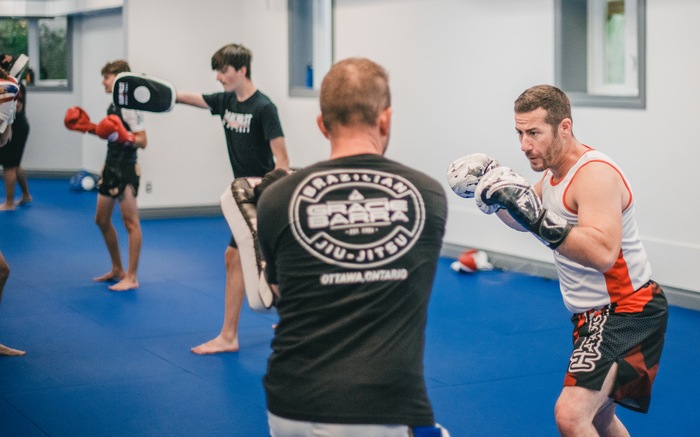
A first Muay Thai class is a lesson, not a test. You warm up, then shadow box, which just means throwing punches and kicks at the air while a coach fixes your stance and your guard. Then comes technique: the jab, the round kick and the teep, a straight push kick. You pair off to hold pads for a partner and swap, so every strike lands on a target somebody is holding still for you. Most sessions finish on the heavy bag.
Notice what is missing. Nobody is throwing anything back at you. Beginners do not spar, and we keep that as a separate class you only join once your fundamentals are solid. If the sparring question is the thing on your mind, we answer it honestly in do beginners spar in Muay Thai.
That first month has a rough shape to it, and we walk through it week by week in your first month of Muay Thai in Ottawa. The headline is that it is gentler than you expect, and the movements that feel impossible in week one start to flow by week four.
What do you wear to Muay Thai?
You need far less than you think for a first class.
Comfortable athletic clothing you can move and sweat in, like shorts or track pants and a t-shirt.
A water bottle, because you will sweat more than you expect.
Bare feet, since Muay Thai is trained without shoes on the mat.
Nothing else. Hand wraps, gloves and shin guards come later, and a good academy will lend you gloves for a first class.
No one shows up to a beginner class fully equipped, so please do not buy a bag of gear before you know you like it. Turn up in what you have and let the coach point you at the rest once you are training regularly.
Is Muay Thai a good workout?
Muay Thai is one of the better full-body workouts you can find, and most people build real cardio and endurance without ever staring at a treadmill clock. The reason is simple. You are learning a skill, so your mind is busy with the round kick and the footwork while your heart rate climbs on its own.
The Canadian 24-Hour Movement Guidelines suggest at least 150 minutes of moderate to vigorous activity a week for adults. Two beginner classes gets most people there, and it rarely feels like fitness for its own sake. You also build strength, balance and coordination as a side effect of practising the strikes, which is why the workout tends to hold people who have quietly given up on the gym.
Can you start Muay Thai with no experience?
Yes, and starting with no experience is the normal way in, not the exception. You do not need a base of fitness and you do not need to be in any particular shape. A coach paces your first weeks around what your body can actually do on the night. If a round on the pads leaves you winded, you slow the pace, drop the power and keep your technique clean. That is the right call, not a failure.
Build the engine and it comes. Wait until you are already fit and skilled first, and you will wait forever.
Who trains Muay Thai in Ottawa?
Muay Thai suits a wider range of people than its reputation suggests. In one week at our academy you will see adults who have never trained a day in their life, teenagers burning off school-day energy and kids learning their first clean round kick.
Adults. The core beginner classes are built for adults of any age and any starting point, from the twenty-something curious about martial arts to the parent getting back into fitness.
Kids ages 7 to 13. Kids Muay Thai teaches striking, focus and discipline in a structured, supportive setting, with the contact kept age-appropriate.
Women who want a women's only start. Being the only woman on the mat can make a first class harder than it needs to be, so we run a women's only Muay Thai class on Sundays, led by Coach Dana. If that is you, our women's only Muay Thai in Ottawa explains how it works.
Whatever the starting point, the fundamentals are taught assuming no background at all. Beyond the fitness, most beginners find the real draw is the discipline and the quiet self-defence confidence that come with training a striking art properly.
Where can I learn Muay Thai in Ottawa?
You can train Muay Thai with us at Gracie Barra Manotick, at 5700 Longshadow St in Manotick, a village inside the City of Ottawa with parking right at the door. We are about twenty minutes from Riverside South and Greely, which is why plenty of our members drive in from across south Ottawa.
The thing that separates one Muay Thai gym from another is not the equipment, it is the coaching. An instructor who teaches on the mat beats a flashy fitness club every time. Coach Panda Dave and the instructors teach hands-on rather than starting a clock and walking away, so your pace on a given night is met where it is. The atmosphere is calm and supportive, and a beginner is never dropped into a room they are not ready for. If grappling ever appeals, plenty of our members also train Brazilian jiu jitsu, or BJJ, so you can add it to your Muay Thai later. You can see the full breakdown and the weekly times on our Muay Thai program page.
Priya S, a south-Ottawa commuter in her late thirties, is a good example of how starting Muay Thai in Ottawa tends to go. She had wanted to begin for three years and kept deciding she was too out of shape first. Her first class was skipping, shadow work and one very winded round on the pads, and she left convinced everyone had noticed. They had not, because most of them had felt exactly the same on their own first night. She trains the beginner pad work twice a week now, and the thing that changed, she says, was realizing the fitness was meant to come from the training, not before it.
Muay Thai for beginners, answered.
Is 30 too old to start Muay Thai?+
No. Most adults in a beginner Muay Thai class started in their late twenties, thirties or forties, and the fundamentals are taught assuming no martial arts background. Starting later usually means training a little smarter about recovery, not training less.
Do you need to be fit to start Muay Thai?+
No. Starting out of shape is the normal way to begin, and the training is what builds your fitness. A coach scales the pace and power of your pad rounds to what you can manage that night, so you improve from wherever you are.
Will I spar in my first Muay Thai class?+
No. A first class is footwork, shadow work, technique, pads and bag work, with no free exchanges. Beginners do not spar, and sparring is a separate class you only join once your fundamentals are solid.
Is Muay Thai good for self-defence?+
Muay Thai builds real composure under physical pressure and a strong base of striking skill. No martial art can promise an outcome in a real situation, which can be unpredictable and involve more than one person, but the honest benefit is confidence and the ability to stay calm and avoid trouble.
What to wear to your first BJJ class: a beginner guide
What should you wear to your first BJJ class?
For your first BJJ class at Gracie Barra Manotick, wear a fitted t-shirt or rash guard and athletic shorts or leggings with no pockets or zippers. You do not need a gi to try jiu jitsu. For a first Muay Thai class, wear a t-shirt and shorts, and train barefoot.
That is the whole answer for a trial. Everything below is the detail, so you can walk in relaxed and focused on the class instead of your clothes. Both our Brazilian Jiu-Jitsu and our Muay Thai programs welcome complete beginners, and the first class is free.
Do you need a gi for your first class?
No. You do not need a gi to try Brazilian Jiu-Jitsu, and buying one before your first class is the most common beginner mistake.
A gi is the traditional jiu jitsu uniform: a heavy cotton jacket, matching trousers and a belt. It is what you grip in gi training, and it is what you will wear once you decide to keep going. For a first class you can train in ordinary athletic clothes and get the full experience. If a loaner gi is available in your size, a coach will offer one on the day.
When you are ready to buy a gi of your own, Coach Panda Dave and the coaching team will point you to the right size and fit. There is no need to sort that out before you have even stepped onto the mats.
Here is the simple version for what to wear by class:
Class
What to wear
BJJ trial (no gi needed)
Fitted t-shirt or rash guard, athletic shorts or leggings, no pockets or zippers
No-gi BJJ
Rash guard, compression shorts or board shorts, spats optional
Muay Thai
T-shirt or tank top, athletic shorts, trained barefoot
What to wear for no-gi BJJ
No-gi is jiu jitsu without the gi jacket, where you grip the body and the clinch instead of the cloth. Because there is no fabric to hold, loose clothing gets in the way, so fitted gear works best.
The standard no-gi kit is a rash guard, which is a snug athletic top that protects your skin on the mat, plus grappling shorts. Many people add compression shorts or full-length spats (compression leggings) underneath. Board shorts or athletic shorts without pockets are fine too. For a first class, a plain fitted t-shirt and shorts will do the job while you decide what you like.
A few things to keep off the mat: no baggy tops that ride up when you grapple, no shorts with pockets that catch fingers, and nothing with a zipper, a button or a hard seam.
What do you wear to Muay Thai?
For Muay Thai you want clothes that let you kick, knee and move freely. Wear a t-shirt or tank top and a pair of loose athletic shorts, and expect to train barefoot on the mat.
Traditional Muay Thai shorts are wide-cut for high kicks, but you do not need them to start. Any shorts that give you full freedom of movement work for a first class. Hand wraps and gloves are useful once you begin pad work, and for your first session the academy can lend or point you to a set, so there is nothing you need to buy in advance. You can see the full striking schedule on our Muay Thai program page.
What BJJ gear do beginners actually need?
Almost none, at first. The honest list of BJJ gear for beginners on day one is short: clean, fitted athletic clothes and a water bottle. Everything else can wait until you know you want to keep training.
As you continue, a typical beginner slowly adds a gi for gi training, a rash guard and shorts for no-gi, and a mouthguard for live rounds. None of it is needed to try a class, and none of it is worth rushing. Our coaches would rather you turn up in a t-shirt than skip a first class because you were waiting on an order to arrive.
What should you bring to your first class?
Bring a full water bottle and a small towel. Wear flip-flops or slides for walking to and from the mat, so your bare feet stay off the change-room and washroom floors. A mouthguard is worth having once you start live rounds, but it is not needed for a first class.
Leave the jewellery at home. Rings, chains, bracelets and earrings can get caught during training and scratch a partner, so it is easier to just not wear them on a training day.
Mat hygiene and safety: what not to wear
Grappling and striking put you in close contact, so a few simple hygiene and safety habits protect you and your training partner. These are the same at every serious gym.
Trim your nails. Short nails on both fingers and toes prevent scratches and are the single most important thing to check before class.
Come in clean clothes. Fresh kit every session, and wash your gi and rash guard after each class to help prevent skin infections.
Tie long hair back. It keeps hair out of your face and out of a partner's grip.
Remove all jewellery. Nothing hard, sharp or metal that can catch or scratch a training partner.
No zippers, buttons or pockets. These can cut skin or trap fingers on the mat.
Sit out with open cuts or a skin infection. Cover a small cut, and stay off the mat if you have anything contagious, for everyone's sake.
The Manotick approach
On a normal evening at our Manotick academy, most first-timers walk in wearing exactly what they would wear to any workout: a t-shirt, shorts or leggings, and bare feet or flip-flops to the edge of the mat. Whether you are driving in from the village, Riverside South or Greely, you do not need to shop first. A coach greets you at the door, shows you where to change, and walks you through the warm-up. If you would like the full picture before you come in, our first visit guide covers how a first class flows from start to finish.
What to wear, answered.
Do you need a gi for your first BJJ class?+
No. You can wear a fitted t-shirt or rash guard and athletic shorts to try Brazilian Jiu-Jitsu. A gi is only needed once you decide to continue, and a coach will help you pick one when you are ready.
What do you wear to Muay Thai?+
Wear a t-shirt or tank top and loose athletic shorts, and train barefoot on the mat. Hand wraps and gloves are helpful for pad work, and the academy can lend or point you to a set for your first class.
Can you wear a t-shirt to BJJ?+
Yes. A clean, fitted t-shirt is perfectly fine for a first class and for no-gi training. Just avoid anything baggy that rides up, and skip shirts with zippers, buttons or pockets that can scratch a training partner.
What should you bring to your first class?+
Bring a full water bottle, a small towel and flip-flops for walking to and from the mat. A mouthguard is worth having once you start live rounds, but you do not need it for a first class.
BJJ vs karate for kids: the best martial art for your child
Is BJJ or karate better for kids?
Neither is better outright. BJJ (Brazilian Jiu-Jitsu) is a grappling art that teaches control, leverage and calm problem-solving on the ground. Karate is a striking art built on punches, kicks, blocks and forms. The right fit depends on your child’s temperament, how they handle contact and what genuinely draws them in.
The right martial art is the one your child keeps turning up for.
Key takeaways
BJJ (Brazilian Jiu-Jitsu) is a grappling art. Children learn control, leverage and calm
problem-solving on the ground, with submissions taught slowly and with control.
Karate is a striking art. Children learn punches, kicks, blocks, stances and forms, with a
clear belt structure and a strong focus on discipline.
The biggest difference is how they spar. In kids BJJ, children do live supervised practice
(rolling) early. In many karate programs, sparring is light-contact, point-based and introduced later.
Neither art is better. The right fit depends on your child’s temperament and what pulls them in.
One free class tells you more than any comparison, and there is no equipment or experience needed.
What does each martial art actually teach a child?
The clearest way to think about BJJ vs karate for kids is grappling versus striking. They are two different answers to the same question of what to do when someone is closer than you would like.
BJJ is grappling. It happens mostly on the ground, which matters because so many real-world scuffles between kids end up on the ground anyway. A child learns to control positions, to escape when they are underneath, and to use leverage so that size matters less than technique. Submissions, which are joint locks and chokes, are taught patiently and always with a partner who can “tap”, a quick signal that means stop. Coaches introduce them slowly and with heavy supervision.
Karate is striking. A child learns to punch, kick, block and move through stances, and to string those movements into kata, which are choreographed forms practised solo. There is real value in that structure. Kata builds coordination, memory and body control, and the belt system, running all the way to a black belt, gives a young child a visible ladder of small wins. In kids karate classes, kids learn those basics through repetition before any contact, and a good kids program keeps the groups small so each child is seen. Karate teaches respect and self-control as seriously as any art does, and the same is true of related striking styles like taekwondo.
Both build confidence the same quiet way, through focus, listening, coordination and the habit of showing up. The difference is the toolkit, and that is what your child will feel on the first day. If you want the grappling side in more detail, our kids BJJ page walks through how a class actually runs.
How is sparring different in BJJ and karate?
This is the difference many parents care about, because it is really a question about contact and safety. In kids martial arts, grappling versus striking changes what sparring looks like.
In kids BJJ, children start live practice, called rolling, within their first few weeks. It looks like supervised wrestling with rules. There are no strikes, nobody is hitting anyone, and a coach is standing over every pairing. A child learns early that being held down is uncomfortable, not dangerous, and that they can stay calm and work out of it.
In many karate programs, sparring (called kumite) is light-contact or point-based, players wear pads, and it is often introduced later once a child has the basics. That is a sensible, careful approach. The honest trade is that a striking match rewards speed and distance, while grappling rewards patience and problem-solving. Kids who dislike being hit sometimes prefer grappling. Kids who dislike being grabbed sometimes prefer striking.
BJJ vs karate for kids: a side-by-side comparison
What matters to a parent
BJJ (grappling)
Karate (striking)
What it teaches
Ground control, escapes, leverage, joint locks and chokes taught with control
Punches, kicks, blocks, stances and kata (solo forms)
How sparring works
Live supervised rolling early, no strikes, tap to stop
Light-contact or point-based kumite, with pads, usually introduced later
Physical style
Close, tangled, weight and leverage
Upright, distance, speed and timing
Suits a child who
Likes wrestling and staying close, thinks under pressure, stays calm being held
Likes to move and kick, wants clear belt milestones, dislikes being grabbed
Builds most visibly
Composure under physical pressure, patience
Coordination, timing, disciplined structure
Which martial art suits which child?
A child who wrestles with siblings, likes being physically close and stays composed when pinned tends to take to grappling quickly. A child who is always moving, loves to kick and thrives on a clear sequence of belts often clicks with striking and the structure karate is known for. Neither of those is a personality test, and plenty of kids surprise their parents. So the best martial art for children is rarely the one that looks best on paper, it is the one your child wants to come back to. This is why a trial class is worth more than any chart. Our programs page lays out the age groups so you can picture where your child would fit.
Marc and Jen L, a Findlay Creek couple, spent a summer stuck between the two. Their seven year old was active and a little shy about contact, and they assumed karate because it was the name they knew. They booked a free BJJ class first, mostly to rule it out. He spent the session laughing through a game of grip-and-escape, tapped a coach on the shoulder and asked to come back on Saturday. They still speak well of the karate club they visited. Their son simply felt more himself on the mats, and that was the answer they had been looking for.
What neither martial art will do
Here is the part the comparison pages skip. No martial art, grappling or striking, will guarantee your child is never bullied, and none of them fixes or cures a condition. A first-year student is not a fighter and should not be treated as one. What good training honestly gives a child is composure under physical pressure, the confidence that comes from handling contact calmly and the option to stay in control rather than escalate. That sits alongside the school and the adults in your child’s life, never instead of them.
What this looks like at Gracie Barra Manotick
We are a Brazilian Jiu-Jitsu academy at 5700 Longshadow St in Manotick, so we will be straight with you: we teach grappling, and kids striking through our Muay Thai program, not karate. Our kids martial arts program starts young: Tiny Champions runs for ages 3 to 5, and Kids Jiu-Jitsu covers ages 6 to 13. Coach Panda Dave leads a team that teaches hands-on rather than watching from the side, and families drive in from Riverside South, Findlay Creek and across south Ottawa. You can see the full week on our schedule. If grappling sounds like your child, the best next step is to watch them try it once.
Choosing, answered.
Is BJJ or karate safer for a young child?+
Both are safe when a class is small and well supervised. BJJ removes strikes entirely, so kids grapple rather than hit, while karate manages contact through pads and light or point-based sparring. The real safety factor is coaching quality and group size, not the style on the sign.
At what age can kids start BJJ or karate?+
Most children can start either one around age 3 to 5, though readiness is about behaviour more than birthday. A child who can follow a two-step instruction, stay with a group and tell an adult when something hurts is usually ready. Our Tiny Champions group starts at age 3.
Does karate or BJJ work better for self-defence for kids?+
Both help, in different ways. Grappling teaches a child to stay calm and in control when someone is close, and striking teaches distance and timing. No art guarantees an outcome, and the most useful skill either one builds is the composure to avoid a fight rather than win one.
Can my child try both before deciding?+
Yes, and we recommend it. A single trial class shows you more than any comparison, because you watch which room your child does not want to leave. Our first class is free, with no experience and no equipment needed.
Gi or no-gi for beginners: which should you start in BJJ?
Should a beginner start with gi or no-gi?
Beginners can start with either gi or no-gi, and most people do not have to choose upfront. Training in the gi builds fundamentals, grip control and patience, while no-gi is faster and more dynamic. At Gracie Barra Manotick our beginner schedule mixes both, so new students meet each style in their first week.
Beginners usually start in the gi. No-gi is a separate class you can add later.
In Brazilian Jiu-Jitsu (BJJ) the gi is the traditional uniform: a heavy cotton jacket, trousers and a belt. No-gi means training without it, in a rashguard and shorts, where you grip the body instead of the cloth. Neither gi BJJ nor no-gi BJJ is the “real” jiu-jitsu, and neither is a beginner mistake. They are two versions of the same art, and the fastest learners usually do a bit of each.
Key takeaways
You do not have to choose upfront. A beginner can start gi or no-gi, and most people train both within a few weeks.
The gi builds fundamentals. Sleeve, collar and lapel grips slow the pace and teach control, patience and clean position.
No-gi is faster and sweatier. It rewards movement and quick transitions, and it is the style closest to wrestling and MMA grappling.
In Manotick, the beginner schedule mixes both. New students meet gi and no-gi in their first week rather than betting on one.
Gi vs no-gi: the key differences for beginners
If you want to learn how to grapple, both styles get you there, they just start you from different places. The whole gi vs no-gi question comes down to one thing: what you are allowed to hold. In the gi you grip the fabric, the sleeve, the collar and the lapel. In no-gi that fabric is gone, so you control an opponent with underhooks, wrists and the clinch. That one change drives most of the differences between the two, and it sets the pace of everything else.
What to compare
Gi
No-gi
Grips
Sleeve, collar and lapel grips on the fabric
Grips on the body: underhooks, wrists and the clinch
Pace
Slower and more methodical
Faster and sweatier
What it builds first
Grip control, patience, precise fundamentals
Movement, scrambles, quick transitions
Closest cousin
Traditional jiu-jitsu
Wrestling and MMA-style grappling
What you wear
A gi jacket, trousers and a belt
A rashguard and shorts
Read down that table of key differences and you can see why coaches disagree in good faith. The two styles reward slightly different habits, so which one is best for beginners depends on what you want to build first. That is really the answer that should help you decide.
What training in the gi teaches a beginner
The gi slows the game down, and for a beginner that is a gift. Those sleeve and lapel grips create friction, which buys you a half-second to think before an opponent moves. You learn to feel where the pressure is, when to be patient and when to go.
That is why so many coaches recommend you train gi first and treat it as your starting point. The grips force clean fundamentals: posture, base, framing and the small body mechanics that a faster style can paper over. They also slow a technique down enough that you can actually feel it working. Guard retention, escapes and control tend to stick better when the pace is methodical. Skills you build in the gi almost always translate to no-gi later, because good position is good position with or without the cloth.
What no-gi jiu-jitsu adds
No-gi is where the game speeds up. Without the gi to slow a scramble, transitions happen at a faster pace and you learn to move, frame and chain submissions on instinct. No-gi grappling is the version closest to wrestling and to the grappling you see in mixed martial arts (MMA), which is why so many competitors and MMA athletes drill it. Advanced no-gi even opens up leg attacks like heel hooks that the gi rules hold back, and it is the format used at events like ADCC. Plenty of beginners find no-gi training more intuitive because there is less to learn about the uniform.
The trade-off is that no-gi can feel slippery early on. Sweat and speed mean you cannot stall behind a grip, so mistakes get punished faster. That pressure is useful once you have a base, and it pairs well with the patience the gi teaches. This is exactly why a beginner does not have to pick: training both makes you a more well-rounded grappler, because the two styles cover each other’s blind spots.
Is gi or no-gi easier for beginners?
Neither is truly easier, they are hard in different ways. No-gi feels faster and simpler at first because there is less gripping to learn, so many new students say it is easier to jump into on day one. The gi feels slower but more technical, and that slower pace is often easier to learn from, because you have time to notice what is happening. Each has its own advantage: no-gi hands you speed, the gi hands you time to think. Older beginners sometimes prefer the gi for that reason, while people who wrestled in school often lean no-gi. In practical, real-life terms most jiu-jitsu practitioners rely on both, so the honest guidance on the gi or no gi choice is simple. Try both and let your own body cast the deciding vote.
A realistic first month for a beginner in Manotick
Picture your first four weeks with us. You show up to a gi fundamentals class on a Monday, borrow a spare gi, and spend the hour drilling one escape and one grip, slowly, with training partners your own size. Nobody throws you into hard sparring. On Tuesday you try a no-gi class in a rashguard and shorts, and the same escape suddenly feels faster and looser. By week three you notice the patience from the gi showing up in your no-gi rounds, and the movement from no-gi showing up in the gi. For beginners in BJJ, that back-and-forth is the whole point, and it is why our beginner schedule runs both within the same week.
Dave R, a Riverside South dad who drives into Manotick twice a week, started convinced he had to choose. He picked the gi because a friend told him it was “proper” jiu-jitsu, then avoided no-gi for two months. When he finally tried a Tuesday no-gi class he realized his gi grips had quietly taught him control that carried straight over. Now he trains both, and he tells every nervous first-timer the same thing: you are not locking yourself in, you are just picking where to start.
How beginners train both at Gracie Barra Manotick
You do not have to solve this before you walk in. Our adult program, led by Coach Panda Dave, runs beginner-friendly gi fundamentals and separate no-gi classes across the week, so you can explore each without committing to one path. Sparring is its own class here, kept apart from the fundamentals hour, so your first weeks stay about learning rather than surviving. Have a look at the adult BJJ program and the weekly schedule and you will see gi and no-gi sitting side by side, which is exactly how we think a beginner should meet them.
Gi and no-gi, answered.
Should you train both gi and no-gi?+
Yes, most coaches recommend training both once you have found your feet. The gi builds patient, precise fundamentals and the no-gi builds speed and movement, and each covers a gap in the other. Beginners start with whichever is running when they arrive and add the second style within a few weeks.
Does training in the gi make you better at no-gi?+
Usually, yes. Grip fighting in the gi teaches control, timing and clean position, and good position carries over whether or not there is fabric to hold. Many practitioners feel their no-gi improves after a stretch of focused gi training, because the fundamentals transfer even though the grips do not.
What colour gi should a beginner get?+
A plain white gi is the safest first choice and is welcome in any class. Blue and black are common too, and most academies are relaxed about colour for beginners. If you are not sure, ask before you buy, and remember your first class needs no gear at all because we lend you one.
Is gi or no-gi better for self-defence?+
Both help, and neither guarantees an outcome. No-gi is closer to how a real situation looks because most people are not wearing a jacket you can grip, while the gi builds the control and composure that matter under pressure. The honest benefit of either is confidence, awareness and the option to stay calm, not a promised result.
Martial arts for kids with ADHD: how structure helps
Is martial arts good for kids with ADHD?
Martial arts can be a strong fit for many kids with ADHD or sensory needs, because a structured class gives a child predictable routine, clear expectations and steady movement. It will not treat or cure anything. What a well-run martial arts class offers a child is a calm, repeatable place to practise focus, impulse control and self-regulation.
Structure, short drills and clear expectations are built into every kids class.
Key takeaways
The structure is the point. A predictable martial arts class, run the same way each time, is exactly the kind of structured environment many kids with ADHD and sensory needs settle into.
Movement is built in. A child gets to burn excess energy on purpose rather than being asked to sit still, which is a hard ask for an ADHD brain.
No single best martial art for an ADHD child exists. The room and the coach matter far more than whether it is jiu-jitsu, karate or something else.
It is not therapy. Martial arts training sits alongside the supports your child already has, never instead of them.
The first class is free. You can watch, or put your child on the mat, and decide nothing until you have seen how they do.
Why structure and predictability help a child on the mat
The thing that overwhelms a lot of kids at school is unpredictability. Martial arts runs the other way.
A class here follows the same shape every time. The same warm-up, the same drills, the same way we line up and the same way we finish. Gracie Barra uses a standardized, structured curriculum across its academies, which in plain terms means the format does not change on your child from one week to the next. For a kid with ADHD or sensory needs, that repetition is not boring. It is what lets them relax enough to actually learn, because they already know what is coming.
Inside that structure there is constant movement. A child is not asked to sit still and absorb a lecture. They are drilling, gripping, moving their whole body, which is where physical activity earns its place for the ADHD brain. Structured exercise is widely linked to better focus and self-regulation, and a martial arts class is structured exercise with a clear goal attached to every minute of it.
There is also a belt system, and it matters more than it looks. Progress comes in small, visible steps, a stripe at a time, on a structured progression a child can see and reach. That is skill-building with built-in delayed gratification, and it gives a kid who struggles with focus a reason to come back and keep working.
What hands-on, small-group coaching looks like here
For a neurodiverse child, who is teaching matters as much as what.
Our coaches teach hands-on rather than standing at the side supervising open training. That means a child gets shown a movement, corrected gently and walked through it again, in the moment, by an adult who is actually on the mat with them. Coach Panda Dave leads our coaching team and teaches both jiu-jitsu and Muay Thai. In a small class a coach knows your kid’s name in the first week, notices when they are getting overloaded and can dial the intensity up or down for that child specifically.
That individual attention is the quiet advantage for a child with sensory needs. Nobody is thrown into the deep end. Partners are chosen deliberately, transitions are signposted, and a child who needs a moment to reset is allowed to take one. None of that is a special program. It is just how a hands-on room already works.
What is the best martial art for an ADHD child?
There is no single best martial art for an ADHD child. The honest answer is that the room and the coach decide the outcome far more than the style on the sign. That said, the arts split into two useful groups.
Grappling arts like Brazilian Jiu-Jitsu and judo teach a child to control a position, escape a hold and use leverage, all without striking anyone. Grappling means wrestling for position rather than throwing punches. Because there is no striking, kids can roll, meaning practise live against a resisting partner, at real intensity without taking shots to the head. Our Kids Jiu-Jitsu program for ages 6 to 13 runs Monday through Friday at 5:45 PM and Saturdays at 10:30 AM, and BJJ tends to suit a child who needs steady, controlled pressure to stay regulated.
Striking arts like karate, taekwondo and Muay Thai teach a child to punch and kick with timing on pads, which are the cushioned targets a partner holds. Kids Muay Thai runs Monday through Thursday at 6:30 PM and builds coordination, timing and motor skill. Karate and taekwondo carry the deepest research base for kids, and again, what those programs share is not the art. It is a curriculum built on rules and self-control, taught by an instructor who enforces them.
Choose the room, not the art. Watch a class, meet the coach and see which one your child walks out of wanting to come back to.
Martial arts, autism and a child with sensory needs
Martial arts and autism can fit together well, for many of the same reasons the structure helps an ADHD child. A predictable, repeatable class with clear expectations gives a child with sensory needs a framework they can rely on. Researchers studying structured, sensory-aware physical activity for autistic children point to gains in motor coordination, self-regulation and social participation when the environment is built around the child.
We do not run a clinical program and we do not make claims we cannot keep. What we can offer is a small room, hands-on coaches and the flexibility to let a child join at their own pace. Some kids need to watch from the edge for a few sessions before stepping on. Some need a partner who moves slowly. That is all workable, and it starts with a conversation. Tell us what your child needs before their first class through our contact page and we will plan around it.
What martial arts will not do
This is where a lot of academies oversell, so we will be plain.
Martial arts will not treat, fix or cure ADHD, autism or a sensory processing difference. Nothing on a mat does that. A class is not a substitute for the therapies, the school supports or the professionals your child already works with, and any program telling you otherwise is selling something.
What a good class does is narrower and real. It gives a child a structured environment, movement with a purpose, a coach who knows them and a sense of steady progress. Those are worth having. They sit alongside everything else your child has going for them, never in place of it. Keep your expectations honest and the mat becomes one more good thing in the week, not a promised transformation.
A first class in Manotick for a child who needs structure
Every season we meet a few families in the same spot. A parent from Manotick, Greely or Riverside South has a child who needs to move, needs structure and has not clicked with a busier, louder activity. They want somewhere small enough to actually help.
We are at 5700 Longshadow St in Manotick village, with parking right at the door, which spares a sensory-sensitive kid a long, loud walk in. The room is small on purpose. You are welcome to sit and watch a full class before your child ever steps on the mat, and you can see everything we run for kids on the programs page or the schedule.
Marcus P, a Greely dad, brought his eight year old in last winter after two activities had not stuck. The first month, his son mostly watched from the edge of the mat and needed the warm-up explained twice. What changed was not dramatic. He learned the shape of the class, started arriving knowing exactly what came next, and stopped melting down at the transitions that used to end every practice. By spring he was lining up on his own and asking to stay for the next group. His parents were careful not to call it a fix, and neither are we. It was just a good hour in his week that he looked forward to.
What parents ask us.
Is martial arts good for a child with ADHD?+
Martial arts suits many kids with ADHD because a structured class offers predictable routine, constant movement and clear expectations in the same room each week. It is not a treatment and makes no medical promise. What it gives a child is a calm, repeatable place to practise focus and self-regulation.
What is the best martial art for an ADHD child?+
There is no single best martial art for an ADHD child. Grappling arts like Brazilian Jiu-Jitsu let kids train live without strikes, while karate, taekwondo and Muay Thai build timing and motor skill. The room and the coach matter more than the style, so watch a class before deciding.
Can a child with autism or sensory needs do martial arts?+
Yes, many children with autism or sensory needs do well in a small, predictable class with hands-on coaching. A child can join at their own pace, watch from the edge first and take a reset when they need one. Tell us what your child needs before their first class and we will plan around it.
Will my child have to spar right away?+
No. Nobody is asked to spar, meaning train against a resisting partner, on their first day. New kids learn the basics with a chosen partner at a controlled pace, and sparring comes much later, only when a child is ready and comfortable.
Muay Thai in Ottawa: your first month as a complete beginner
What is your first month of Muay Thai in Ottawa like as a complete beginner?
Your first month of Muay Thai in Ottawa is built around fundamentals, not fighting. As a beginner you learn stance, footwork and basic strikes on pads and bags, with a coach scaling the conditioning to your fitness. Nobody spars in the early weeks, and no experience or equipment is needed to start.
Your first month is footwork, pad rounds and getting used to the room.
Key takeaways
You do not need to be fit or experienced to start Muay Thai in Ottawa, and your first month is gentler than you expect.
Fitness is not a prerequisite. A coach scales the conditioning and pad work to whatever shape you are in on the night.
Month one is fundamentals, not fighting. You learn stance, footwork, the jab, the round kick and pad work.
Nobody spars in the early weeks. Every strike you throw lands on a pad or a heavy bag, never a partner.
You need almost nothing. Comfortable clothes, a water bottle and bare feet cover a first class, and we can lend you gloves.
Sore shins are normal in weeks one and two. They settle as your body adapts, and by week four the movements start to feel natural.
What actually happens in your first Muay Thai class
A first class is a lesson, not a test.
You warm up, then shadow box, which just means throwing punches and kicks at the air while a coach fixes your stance and your guard. Then comes technique: the jab, the round kick, the teep, which is a straight push kick, and how to keep your hands up. You pair off to hold pads for a partner and then swap, so every strike lands on a target somebody is holding still for you. Most sessions finish on the heavy bag.
Notice what is missing. Nobody is throwing anything back at you. The whole first month is about teaching your body a few clean movements, not about taking a hit.
What to bring to your first Muay Thai class
You need far less than you think.
Comfortable athletic clothing you can move and sweat in, like shorts or track pants and a t-shirt.
A water bottle, because you will sweat more than you expect.
Bare feet, since Muay Thai is trained without shoes on the mat.
Nothing else. Hand wraps, gloves and shin guards come later, and a good academy will lend you gloves for a first class.
Do I need to be fit to start Muay Thai?
No. You get fit by training, not before it.
This is the honest part most pages skip. You do not need a base of fitness to start Muay Thai, and starting out of shape is the single most common way people begin. A coach paces your first weeks around what your body can actually do that night. If a round on the pads leaves you winded, you slow the pace, drop the power and keep your technique clean, and that is exactly the right call, not a failure.
Muay Thai builds cardio and endurance in a way that a treadmill rarely holds anyone’s attention long enough to match. The reason is simple. You are learning a skill, so your mind is busy with the round kick and the footwork while your heart rate climbs on its own. Health Canada and the Canadian 24-Hour Movement Guidelines suggest at least 150 minutes of moderate to vigorous activity a week for adults, and two beginner classes gets most people there without it ever feeling like a workout for its own sake.
Build the engine and it comes. Wait until you are already fit and you will wait forever.
The first month, roughly, week by week
No two beginners move at the same pace, so treat this as a rough shape rather than a schedule.
Week
What you work on
How it usually feels
Week 1
Stance, guard, the jab and the basic round kick
Awkward and busy. You will feel like your limbs belong to someone else, and that is normal.
Week 2
Footwork, the teep, holding pads for a partner
The soreness peaks, especially the shins. It settles as they toughen up.
Week 3
Linking two or three strikes together, simple defence
Things start to click. A combination that felt impossible in week 1 starts to flow.
Week 4
Cleaner pad rounds, a touch more pace, breathing under fatigue
You catch yourself moving without thinking. This is the moment most people decide to stay.
The shins deserve a word, because they surprise people. In the first couple of weeks a barefoot beginner often gets sore shins from the heavy bag and bruised forearms from holding pads. That fades as the tissue adapts. Sharp pinpoint pain or swelling that worsens is different, and it means stop and get it looked at.
What Muay Thai actually is
Muay Thai is a striking martial art from Thailand, often called the art of eight limbs because it uses fists, elbows, knees and shins as eight points of contact. For a beginner that mostly means you have a wider toolkit than boxing, so the first month can feel like a lot of new information at once.
Do not let the range of it intimidate you. In month one you are really only learning to punch, to kick and to move, and the elbows and knees come in slowly and safely later. Beyond the fitness, most beginners find the real draw is the discipline and the quiet self-defence confidence that come with it. A calm, supportive atmosphere and an instructor who actually teaches on the mat beats a flashy gym every time.
Priya S, an Ajax-to-Ottawa commuter in her late thirties, is a good example of how starting Muay Thai in Ottawa tends to go. She had wanted to start for three years and kept deciding she was too out of shape first. Her first class was skipping, shadow work and one very winded round on the pads, and she left convinced everyone had noticed. They had not, because most of them had felt exactly the same on their own first night. She trains the beginner-friendly pad work twice a week now, and the thing that changed, she says, was realizing the fitness was supposed to come from the training, not before it.
How we pace a first month at Gracie Barra Manotick
Our timetable is built so a beginner is never dropped in over their head. Muay Thai Pad Work runs Monday through Thursday at 7:15 PM and Saturday at 11:15 AM, and it is the natural starting point, since every strike lands on a pad or a bag. The livelier Drills and Sparring class is a separate slot later in the evening, and a new student simply is not in that room until Coach Panda Dave says the time is right.
We are at 5700 Longshadow St in Manotick, with parking at the door, about twenty minutes from Riverside South and Greely. Coach Panda and the instructors teach hands-on rather than starting a clock and walking away, so your pace on a given night is met where it is. If being the only woman on the mat is part of the worry, Women’s Only Muay Thai runs Sunday from 11:15 AM to 12:15 PM. For an even gentler first taste of striking, Family Boxing on Friday at 6:30 PM is the lowest-contact option we run. Plenty of our members also train Brazilian Jiu-Jitsu, or BJJ, so if grappling ever appeals you can add it to your Muay Thai later. You can see the whole week on our schedule, and the Muay Thai Ottawa page has the full beginner breakdown.
First-month questions.
Is 30 too old to start Muay Thai?+
No. Most adults in a beginner Muay Thai class started in their late twenties, thirties or forties, and the fundamentals are taught assuming no martial arts background. Starting later usually means training a little smarter about recovery, not training less.
Do I need to be in shape to start Muay Thai?+
No. Starting out of shape is the normal way to begin, and the training is what builds your fitness. A coach scales the pace and power of your pad rounds to what you can manage that night, so you improve from wherever you are.
Will I get hit in my first Muay Thai class?+
No. A first class is footwork, shadow work, technique, pads and bag work, with no free exchanges. The only impact you feel is your own strikes landing on a pad or a bag, never a partner throwing back at you.
What should I bring to my first Muay Thai class?+
Comfortable athletic clothing, a water bottle and bare feet for the mat. That is all you need. Hand wraps, gloves and shin guards come later, and we can lend you gloves for a first class in Ottawa.
Am I too old to start BJJ? The honest answer at 30, 40 and 50
Am I too old to start jiu-jitsu?
No, you are not too old to start jiu-jitsu at 30, 40 or 50. Adults begin Brazilian Jiu-Jitsu in all three decades, often with no martial arts background. What changes with age is recovery time, how carefully you warm up and who you train with, not your ability to learn the sport.
Most adults in our beginner class started with no martial arts background at all.
What is the maximum age to start BJJ?
There is no maximum age and there is no cutoff. The clearest evidence for that is how the sport organizes itself: the IBJJF, the largest governing body in Brazilian Jiu-Jitsu, runs Masters brackets that begin at 30 with Master 1 and continue in five-year steps all the way to Master 7, which is 61 and over. A sport with a bracket for 61 year olds is not a sport with an expiry date on the door.
You do not need to compete for that to matter to you. It matters because it tells you the room you are about to walk into was built for people of all ages, not only for 22 year olds with fresh knees. Most adults who started BJJ later in life will tell you the same thing: the wall they expected was never really there.
What follows is the honest version, decade by decade. Not a pep talk, and not a warning.
Starting in your 30s: recovery, not capacity
In your thirties, almost nothing about your capacity to learn has changed. You can still drill, you can still grapple, you can still build the conditioning the sport asks for. Drilling just means repeating a movement with a willing partner until it stops feeling foreign.
What shifts first is recovery time. The research here is reasonably settled: your muscles still respond well to hard training as you get older, but the response is somewhat blunted compared with your twenties, and the gap between hard sessions matters more than it used to. In practice that means two good sessions a week with real sleep between them will build a better white belt than four rushed ones on five hours of sleep.
The other thing that changes in your 30s is your excuse quality. The job is busier, the kids are smaller and the day is fuller. That is a scheduling problem, not an age problem, and it has a scheduling answer.
Starting jiu-jitsu in your 40s: old injuries and warm-up time
The 40s are less about decline and more about inventory. Most people arriving at this age bring something with them: a lower back that complains after long drives, a knee from an old soccer season, a shoulder that does not love overhead movement, a neck that stiffens at a desk.
None of that disqualifies you. It just needs to be said out loud on your first night, to the coach, before you step on the mat. A coach who knows about your knee can give you a different version of a movement in about four seconds. A coach who finds out afterwards cannot.
Connective tissue is the one genuinely important detail here. Tendons and ligaments remodel more slowly than muscle does, at every age, and that gap is part of why sensible progressions get more conservative as you get older. Your strength can outrun your joint tissue if you let it. The fix is unglamorous: add load gradually, keep your mobility work honest and stop treating soreness and pain as the same signal.
On warm-ups, we will be straight with you, because plenty of martial arts blogs are not. There is no strong body of age-comparison research proving that a 45 year old needs a longer warm-up than a 25 year old. What there is, is a great deal of consistent gym-floor experience saying that older beginners feel better and train longer when they ramp up gradually rather than starting cold. We treat that as practical wisdom, not as science, and we build the class that way regardless.
Is 55 too old to start Jiu-Jitsu?
No, and the 50s change the question in a useful way. By this decade the deciding factor is rarely fitness and almost never intelligence. It is partner selection.
Rolling is the sport’s live practice, closer to physical chess than to fighting, where two people start from a position and work for a better one. A tap, which is a clear signal with the hand or the foot, ends the exchange instantly and carries no shame whatsoever. Who you do that with is the single biggest lever you have over your injury risk.
Good training partners for an older beginner are experienced, calm and controlled. They know how to move around a new person without using raw strength. The partner to be careful with is not the black belt, it is the enthusiastic newer person who is still learning that a choke does not need to be rushed. You are allowed to choose. Saying “I would rather sit this round out and watch” is a normal, unremarkable sentence in an academy, at any age.
What adjustments should older beginners make when starting BJJ?
Tell your coach everything on night one. Every old injury, every surgery, every joint that acts up.
Start with two sessions a week, not five. Regular training beats heroic training. Consistent practice
is what actually moves your progress.
Warm up before you arrive. A short walk or a few minutes of mobility work before the drive helps.
Drill more, spar less, in the first month. The technical work is where the learning lives anyway.
Learn to tap early and without ego. It takes nothing from you and protects everything.
Listen to your body between sessions, not during. Soreness is information. Sharp pain is a stop sign.
Expect progress to take longer, and to arrive anyway. Nobody is timing you.
Is it worth it to do jiu jitsu only once or twice a week?
Yes, and for most adults starting later in life, twice a week is the correct dose rather than a compromise. The mistake is not training too little, it is starting at five days, feeling wrecked by week three and stopping altogether.
This is where our schedule genuinely helps. We run 51 classes a week across all seven days, which means a realistic two-day week actually exists for someone with a desk job and a family. A 45 year old in Manotick might take Adult BJJ fundamentals on Monday at 7:15 PM, then the Saturday morning open mat, which runs from 9:00 to 11:15 AM. That is four full days of recovery between sessions, one weeknight the family barely notices and a weekend slot that does not eat the day. If Monday falls apart, Wednesday at 7:15 PM catches the same fundamentals class.
People drive in from Riverside South and Greely for exactly that reason, and they park at the door. You can see the full timetable on our schedule, and the adult BJJ program page walks through how the fundamentals classes are structured.
Marc L, a Riverside South dad of two, first emailed us at 46 and then waited another five months before booking anything. He had a lower back that had been unhappy since a renovation project and a real fear of being the oldest person on the mat. He was not, as it turned out. He started twice a week, sat out live rounds entirely for his first three weeks and told every partner about his back before they started. What he mentions now is not technique at all, it is that he sleeps better and that he stopped feeling like the only person his age who had let fitness slide.
What older beginners ask.
Is 70 too old to start Jiu-Jitsu?+
It is not too old, provided you train with a coach who adjusts the session to you and you have your physician’s clearance first. At that age the emphasis shifts almost entirely to technical drilling, controlled positions and carefully chosen partners rather than hard live rounds.
Is it too late to start BJJ if you are out of shape?+
No. You do not need to be in good shape to begin, because the classes themselves build the cardio and conditioning over time. Starting where you are is normal here, and nobody in that room is measuring you against anything.
What should an older beginner expect in their first month of BJJ?+
Expect to be tired, sore in unfamiliar places and confused for the first few weeks, which is universal and not age related. Expect to learn the tap, some basic positions and a handful of names. Most people find the first month is more about comfort in the room than about technique.
Is 40 too old for BJJ?+
No. Forty is a very common age to start, and it sits comfortably inside the sport’s Masters age brackets. The adjustments that matter at 40 are a longer warm-up, honest communication about old injuries and two consistent sessions a week rather than five ambitious ones.
Do beginners spar in Muay Thai? When you really start
Do beginners spar in Muay Thai?
No. Beginners do not spar in Muay Thai on day one. A first Muay Thai class is footwork, shadow work, bag work and pad work with a coach. At a well-run academy, new students train fundamentals for weeks or months before any light technical sparring, and contact sparring stays optional after that.
Pad work and sparring are separate classes here. You choose when, and if, you spar.
What a beginner Muay Thai class is made of
It is a skills lesson, not a fight.
You warm up, then shadow box, which means throwing punches and kicks at the air while a coach fixes your stance, your guard and your footwork. Then comes technique: the jab, the round kick, the teep and how to check a low kick with your shin. You pair off to drill, holding pads for a partner and then swapping, and most sessions finish on the heavy bag.
Notice what is absent. Every strike you throw on your first day lands on a bag or on a pad somebody is deliberately holding still for you. Nobody is throwing back.
Will I get hit in my first Muay Thai class?
You will feel impact, which is not the same as being hit. Holding pads means absorbing a partner’s kicks through the leather, and your own shins will find the heavy bag more than once.
What you will not get in a properly run beginner session is another person freely striking at your head while you try to defend yourself. That is sparring, and it is a separate activity you opt into later. Beginners who get hurt in a first class have nearly always been dropped into free exchanges by a room that mistook that for toughness. It is simply unsafe.
How long until you start sparring in Muay Thai?
There is no single number, and any coach who gives you one before watching you train is guessing.
Across well-run academies the common range runs from roughly two to six months of consistent work before a beginner is cleared for light sparring. Some structured programs clear suitable students after an eight-week course. Conservative rooms wait six to twelve months, especially for beginners with no athletic background, and plenty of people train for years without ever taking a hard round. Muay Thai does not use a belt system the way BJJ does, so being ready to spar is a coach’s judgment rather than a rank you are handed.
What a coach is watching for is concrete:
Can you hold a stance and keep your hands up when tired?
Can you control the power of your own knee or kick and stop a technique halfway?
Can you take an instruction mid-round and change what you are doing?
Do you breathe when the pace lifts, or do you panic and swing?
That last one is the real gate. A beginner who cannot yet regulate their own intensity is a hazard to a partner as much as to themselves.
Light technical sparring, hard sparring and what a hobbyist needs
Most people who fear sparring are picturing the wrong version of it.
Light technical sparring is live and unscripted, but both partners deliberately pull their strikes and work at roughly 20 to 30 percent of fight power. The goal is distance, timing and defence. It often starts narrower still: body only, jab only, or one person attacking while the other purely defends.
Hard sparring is realistic pace and real impact. It belongs to people preparing to compete in boxing or Muay Thai or MMA, and even then in small doses. A hobbyist training two nights a week never needs to spar hard to get better. In Thailand, where the sport grew up, a fighter’s daily work is pads, bags and clinch rather than constant hard rounds.
The Muay Thai clinch is the close-range position where you control a partner’s head and arms. It is where the art starts to grapple, and beginners often find it the least frightening part.
Muay Thai sparring tips for your first spar
The first time you spar, a trusted partner matters more than any technique. A few things also help:
Ask your sparring partner for a target intensity out loud before the round starts.
Keep it low-power and go for one clean technique rather than five rushed ones.
Breathe. Holding your breath is what turns a light round into a panic.
Treat the person opposite you as a partner rather than an opponent, and say so at once if the pace climbs past what you agreed. Good etiquette is normal, not rude.
Is Muay Thai dangerous for beginners?
It is a contact sport, so no honest coach will claim the risk is zero. What we can tell you is what month one actually looks like.
The real complaints are dull: sore shins from the heavy bag, a bruised forearm from holding pads badly, tight hips and blisters from pivoting barefoot. Ordinary soreness for a day or two is normal. Sharp pinpoint bone pain, swelling that worsens or pain at rest is not, and it means stop and get it assessed. Most beginner injury comes from doing too much too soon, not from contact.
Head contact deserves a straight answer. The Association of Ringside Physicians advises minimizing head shots in training and using properly padded gloves, and its position is that headgear reduces cuts but is not proven to prevent concussion. A mouthguard is required for any sparring, along with shin guards. Research on customary sparring found measurable short-term changes in memory and motor control after only three three-minute rounds, which is exactly why a beginner has no business doing volume head work. Headache, dizziness or nausea means you stop for the day and see a physician.
None of that argues against training. It argues for training somewhere that gates sparring as a supervised skill.
What it means when a gym spars beginners hard right away
This tells you more about a place than its marketing does. If a gym drops a first-timer into a hard round to see how they cope, you have learned three things. Nobody is supervising the room, which lets the most reckless student set the pace. The experienced students have not been taught etiquette. And the place is built around the few athletes who might compete, at the expense of everyone else. Ask the question directly on your first visit, and treat a vague answer as an answer.
How a coach paces sparring at Gracie Barra Manotick
Our timetable settles this before anyone has to ask. Sparring is not buried inside the beginner class. It has its own slot.
Muay Thai Pad Work runs Monday through Thursday at 7:15 PM and Saturday at 11:15 AM. Muay Thai Drills and Sparring is a different class at a different time, Monday through Thursday at 8:15 PM and Saturday at 12:00 PM. A new student trains pad work and is simply not in the room for the later session until Coach Panda Dave says otherwise. Nobody declines anything in front of a crowd. You can see the full week on our schedule.
For an even gentler door into striking, Friday Family Boxing at 6:30 PM is the lowest-contact option we run. It is built for parents and kids working mitts together, and plenty of nervous adults get their first taste of contact there. The same pacing applies to a new boxer or anyone arriving from kickboxing. There is also Women’s Only Muay Thai on Sunday from 11:15 AM to 12:15 PM, for anyone who would rather not be the only woman on the mat on night one.
We are at 5700 Longshadow St in Manotick, parking at the door, about twenty minutes from Riverside South and Greely. Our coaches teach hands-on rather than starting a clock and walking away. Our first visit page covers what to bring, and the Muay Thai program page has the full breakdown.
Nadia R, a Riverside South mother of two, sat in our parking lot most of a Tuesday evening before she came in. She had spent a year telling herself she would try Muay Thai for beginners in Ottawa once she was fitter, and the sparring question was the real reason she kept stalling. Her first class was skipping, shadow work and forty minutes on the pads. She has trained the pad work nights since spring and has not taken a sparring round yet, entirely her call. What changed, she says, is that she stopped rehearsing the worst version of the room in her head.
Sparring, answered honestly.
Do beginners spar on their first class?+
No. A first Muay Thai class is warm-up, shadow work, technique, pads and bag work, with no free exchanges. Any contact you feel comes from striking a pad or a bag, not from a partner throwing at you.
How often should beginners spar in Muay Thai?+
Once a beginner has been cleared, a light technical sparring session roughly once a week is plenty, and skipping it entirely is a legitimate choice. Volume should stay low, because the real skill gains come from drills and pad work rather than hard rounds.
What equipment do beginners need for Muay Thai sparring?+
A mouthguard, shin guards and proper sparring gloves, which for most adults means 16 ounce gloves rather than worn-in bag gloves. You need none of this for a first class, where hand wraps and comfortable clothing are enough.
Is 27 too old to start Muay Thai?+
No. Most adults in a beginner class started in their late twenties, thirties or forties, and the fundamentals are taught assuming no martial arts background at all. Starting later usually means training smarter about recovery, not training less.
Kids martial arts in Ottawa: what age can a child start?
What age can a child start kids martial arts in Ottawa?
Most children can start kids martial arts in Ottawa at about age 3, but the honest answer is behavioural rather than a birthday. A child is ready when they can follow a two-step instruction, stay with a group, tell an adult when something hurts and be close to other children. Age is a rough guide. Behaviour is the real test.
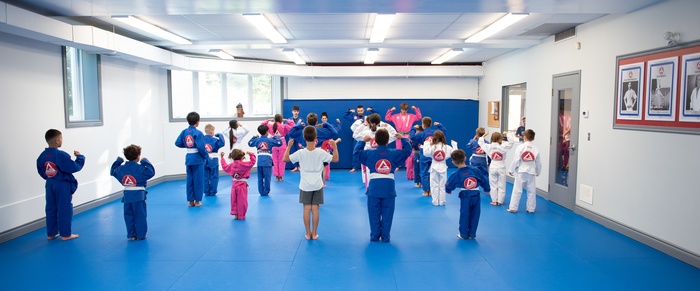
Our Tiny Champions class starts at age three, built around focus and listening.
The readiness signs that matter more than a birthday
A martial arts program is not a birthday club. Two children the same age can be a year apart in the things that actually make a class work, so this is what we watch for on a first visit. None of it requires your child to be athletic, confident or outgoing.
Can they follow a two-step instruction?
This is the big one. “Put your water bottle down and sit on the line” is the shape of almost everything a coach says in a kids class. The CDC’s developmental milestones put two- and three-step directions at around age 3, and most children we meet can manage it by four. Test it at home when your child is a little excited or distracted, because that is the version we get on the mat.
Can they stay with a group for half an hour?
Not sit still for half an hour. No four year old does that, and any martial arts school promising it is describing a room you would not want your child in. The CDC puts sustained attention at roughly five to ten minutes for a five year old, which is why our youngest class runs as a string of short games, short drills and short rests rather than one long lesson. The question is whether your child can come back to the group after each break, not whether they can hold focus straight through.
Can they tell a coach when something is wrong?
This one is not negotiable, because it is a safety rule rather than a nice-to-have. A child needs to be able to say “stop,” “that hurts” or “I need help,” or use a signal a coach can read across the room. In grappling especially, the tap, which means a light tap on your partner to end the exercise immediately, only works if a child will actually use it.
Are they all right being close to other kids?
Martial arts involves contact. Your child does not need to love it, and they certainly do not need to be forced into it. What they need is to be able to stand near other children without being overwhelmed, accept an explained touch like a high five or a coach adjusting a hand, and both say stop and respect another child’s stop.
Is my child ready for martial arts? A quick parent checklist
Run through this at the kitchen table before you book anything. Three or four yes answers is plenty to start with.
Readiness sign
What it looks like at home
Two-step instructions
“Get your shoes and come to the door” works without three reminders
Re-engaging
They wander off mid-activity but come back when called
Separation
They settle within about ten minutes after you leave
Speaking up
They tell you when something hurts, itches or scares them
Proximity
They can play beside other children without needing to be peeled away
Movement
They run, jump, climb and get up off the floor with confidence
How our martial arts academy groups the youngest students
We do not put a four year old in with a nine year old and hope for the best. Our kids martial arts classes are split by age first, because a room of similar-sized children is the single biggest safety factor in the whole building.
Tiny Champions, ages 3 to 5. Monday to Friday at 5:00 PM and Saturday at 10:00 AM. Short
segments, animal walks, balance games, listening games and the first pieces of Jiu-Jitsu, which is the grappling art of controlling and being controlled on the ground.
Kids Jiu-Jitsu, ages 6 to 13. Monday to Friday at 5:45 PM and Saturday at 10:30 AM. More
structure, more partner work, real martial arts techniques taught in order.
Kids Muay Thai, Monday to Thursday at 6:30 PM. Muay Thai is a striking art using hands, elbows,
knees and shins, taught here on pads, which are the thick foam targets a coach or partner holds. Parents often type kickboxing into a search bar when this is the class they actually mean.
The whole schedule sits on our class schedule page, and the age groups for the younger students are set out on the kids Jiu-Jitsu page. Some schools call the training room a dojo. We just call it the mat, and it is the same mat for students of all ages, including our adult martial arts classes later each evening.
What a first class looks like for a four year old
A parent walks in with a child who has never done a structured activity. Here is the honest version of the next forty minutes. Your child keeps their socks on until the mat, then goes barefoot. A coach meets them at the edge, not in the middle. They line up with five or six other children who are also new-ish, and the first ten minutes is running, crawling and falling over on purpose, because learning to fall is the first real skill in this sport.
You stay. You do not have to hand a four year old over at the door and disappear on day one. Tell the coach it is their first time, sit at the side of the mat and expect a good number of new Tiny Champions to spend the first class holding a parent’s hand for the first five minutes and then forgetting entirely that the parent is there. If your child melts down, that is information, not failure. We try again another week. Our first visit page walks through the practical parts, and no gi, which is the traditional training uniform, is needed for a first class.
What martial arts training will not do
This part matters more than the brochure part. Martial arts will not stop your child being bullied. No art can promise that, and anyone who says otherwise is selling something. What it can offer is narrower and truer: composure when someone puts hands on them, and the option not to escalate. That sits alongside the school and the adults involved, never instead of them.
It will not fix a diagnosis, and it is not a substitute for anything a paediatrician or a teacher is already doing. It will not turn a shy four year old into a loud one. And it does not come with a timeline. We do not tell parents when a black belt arrives, because we do not know, and any number we gave you would be invented.
What quality martial arts does reliably deliver is physical fitness, a room where a child learns socially and emotionally how to lose gracefully and the slow kind of confidence that comes from being visibly better at something in March than you were in September. Paediatric guidance also recommends non-contact skill work before any sparring for young children, and discourages mixed martial arts at this age. That matches how we run it.
Martial arts classes in Ottawa, and the fall window you are actually in
OCDSB students go back on Tuesday 1 September 2026, ahead of Labour Day on 7 September, which makes this an unusually compressed few weeks for south-end families. Most of the Manotick, Riverside South and Greely parents we meet are locking in the whole school year in about three weeks, and the 5:00 PM and 5:45 PM start times are the ones that fill first because they clear the dinner hour.
We are at 5700 Longshadow St in Manotick, one of Ottawa’s south-end villages, with parking at the door and no downtown drive. Families come in from Findlay Creek, Osgoode and Kars, which is a fair reflection of how spread out the Ottawa community around this village really is. If you are comparing martial arts in Ottawa on a map, we are the one you can reach without crossing the city.
Ayla R, a Riverside South mom of two, brought her four year old in last September mostly because soccer had not gone well. The first class, he stood at the edge with his hands over his ears for about eight minutes. Coach Panda Dave gave him a spot on the wall to watch from and did not push. By the third week he was lining up on his own, and by November he was the one telling his mother it was Tuesday. She says the change she noticed first was not on the mat at all, it was that he started telling adults when something bothered him.
What parents ask us first.
What age can kids start jiu jitsu?+
Most academies, including ours, start structured Jiu-Jitsu classes at about age 3, and our Tiny Champions program runs for ages 3 to 5. Readiness matters more than the number, so a child who can follow a two-step instruction and speak up when something is wrong is usually ready.
Will martial arts make my child more aggressive toward their peers?+
In our experience the opposite is more common, because the whole class is built on control, stopping on command and respecting a partner’s stop. We cannot promise a behaviour outcome for any individual child. What we can say is that aggression in class is corrected immediately, every time.
What do I need to bring to my first martial arts lesson?+
Nothing but water, comfortable clothes with no zippers or buttons and bare feet on the mat. We say no equipment is needed for a first class and we mean it, so leave the shopping until your child has decided they like it. Long hair tied back, nails trimmed short.
Will my child learn to defend themselves should they ever have to?+
They will learn real self-defence skills, and we will be honest about the limits. A real situation is unpredictable and can involve more than one person, so no art guarantees an outcome. The dependable benefit is composure under physical pressure and a much better instinct for avoiding trouble.
Martial arts for bullying: what bully prevention changes for kids
Does martial arts help with bullying?
Martial arts help with bullying indirectly, not by teaching a child to win fights. Training builds composure under physical pressure, steadier posture and the confidence to say no out loud. Research links structured, instructor-led martial arts to lower aggression and higher resilience in children. No martial art stops bullying on its own. Adults and schools still have to act.
Composure under physical pressure is the honest thing training gives a child.
What martial arts training changes first, and how kids build confidence
The first changes are physical, and small enough that most parents miss them for weeks.
A kid who has been calmly held down and worked their own way out stops flinching when someone crowds them. That is the whole mechanism. Panic makes a child freeze, and a child who has felt that pressure a hundred times in a safe room does not spend the first three seconds of a confrontation panicking. Those seconds are the difference between saying something and saying nothing.
What parents notice, in rough order:
Posture. Head up, shoulders back, less of the folded-in stance that marks a child as an easy target.
Eye contact. Holding a gaze a beat longer instead of looking at the floor.
Voice. Saying “stop” at a volume an adult six metres away can hear.
Willingness to say no. Out loud, in the moment, without rehearsing it first.
Be honest about the timeline. This is a slow build measured in months, not a fix measured in weeks. A shy kid does not walk out of their first class transformed, and anyone who says otherwise is selling something. Self-confidence comes from accumulated evidence, and that takes time.
The research agrees. A randomized trial of 283 primary school children aged 8 to 12 found a ten-week traditional martial arts program improved resilience and self-efficacy while those measures declined in the control group. Real, measurable and modest. Not a personality transplant.
Does Jiu-Jitsu help with bullying?
Jiu-Jitsu fits this problem better than most arts, for one plain reason. Bullying at school is rarely a boxing match. It is a shove, a grab at a backpack, a kid sitting on another kid. That is grappling, meaning wrestling for position rather than striking, and it is exactly what jiu-jitsu trains.
Brazilian Jiu-Jitsu teaches a child to escape a grab, get out from underneath someone and create enough space to stand up and leave. None of that requires a punch or a kick. That matters more than it sounds, because a child who answers a shove with a fist is the child who gets suspended, regardless of who started it. A child who stands up, steps back and walks to a teacher has not broken a school rule.
Another benefit. Because jiu-jitsu has no striking, kids can spar, meaning practise against a resisting partner, at realistic intensity without taking shots to the head. Emotional regulation under physical stress is a skill built only under physical stress. Our Kids Jiu-Jitsu program runs Monday through Friday at 5:45 PM and Saturdays at 10:30 AM, and that is where most of this work happens.
We teach the striking side as well. Kids Muay Thai runs Monday through Thursday at 6:30 PM and builds coordination, timing and self-discipline.
Which is the best martial art for kids dealing with bullies?
There is no single best martial art for kids, but the arts split into two groups and one fits this problem better.
Grappling arts cover Brazilian Jiu-Jitsu, judo and wrestling. They teach control, escapes and takedowns, all usable without striking anyone. Striking arts cover karate, taekwondo, boxing and Muay Thai. They teach a child to punch and kick with timing, and build real self-discipline and coordination.
For a child being shoved, grabbed or held down, grappling gives more directly usable self-defence skills. The reason is practical. A child who ends a shoving match by controlling someone and standing up has done nothing a principal can call fighting. A child who answers a shove with a kick has, whatever the provocation.
That is not an argument against striking arts. Karate and taekwondo carry the deepest research base here, and most studies showing reduced aggression in children ran in traditional karate and taekwondo programs. What those programs share is not the art. It is a curriculum built on rules, respect and self-control, taught by an instructor who enforces them.
Choose the room, not the art.
Will martial arts make my child aggressive?
This is the fear underneath the question, and it deserves a straight answer.
The evidence points the other way, with conditions attached. A meta-analysis of twelve child and youth studies found eleven showed reduced externalizing behaviour, including physical aggression and bullying, with a medium average effect. A school study of 254 grade five students found that boys who attended more sessions of a martial arts based anti-bullying curriculum reported less aggression and were more likely to step in for a classmate, and that the change ran through increased empathy.
Now the conditions. A 2026 systematic review in Frontiers in Public Health looked at eleven longitudinal studies and found no consistent direction. Some programs reduced aggression, some changed nothing, and a few saw it rise. The training environment decides the outcome. Programs built on rules, respect and self-control reduce aggression. Loosely supervised rooms where winning is the only value sometimes do the opposite.
So martial arts do not make a child aggressive, but a badly run room can. Ask about the instructor and watch a class before enrolling your child anywhere. If the coaching is hands-on and the rules are enforced, the aggression question mostly answers itself.
What martial arts will not do for bully prevention
No martial art will stop your child being bullied. We will not tell you otherwise, and any bully prevention program promising it is overselling.
A study of 331 young karate athletes aged 11 to 18 found that more than three quarters had experienced at least one form of bullying. Read that carefully. Kids often start martial arts classes because they are already being targeted, and the training does not automatically end it. Bullying is a group behaviour driven by social status and bystanders, and one child’s grappling does not change a classroom’s norms.
Be sceptical of any anti-bullying program promising your child will be less likely to be targeted. The effects of bullying are psychological as much as physical, and no belt fixes that. What martial arts training does is help children build self-esteem, self-control and a calmer response to confrontation. Worth having. Not a guarantee.
The evidence on fighting back is worse than most parents expect. Children who hit back are more likely to still be bullied six months later. In one long-running study, boys who fought back saw no change in how often they were victimized, while boys who brought in a friend saw it drop. Retaliation is a poor strategy, and it is the one most parents quietly hope martial arts will teach.
What works is adults. PREVNet, the Canadian research network on bullying, puts it plainly: bullying is a relationship problem that requires relationship solutions. Their parent guidance is to take the report seriously, tell the school, keep a written record, work with staff on a plan and follow up over weeks. Whole-school programs reduce victimization measurably. One child’s training does not.
Training sits alongside all of that. Never instead of it.
How to outsmart a bully without a physical fight
What we actually teach kids, in order, is unglamorous:
1. Leave if you can. Walking away is a decision, not a failure. It works and it risks nothing. 2. Say it loud and say it once. “Stop. I don’t like that.” Head up, eyes on them, said at a volume that carries. 3. Tell an adult, then tell another one. It often takes more than one before anything changes. That is not a reason to stop. 4. Stay with people. Kids are targeted far less often when they are not alone. 5. Use your hands only to protect yourself and get away. Control, stand up, leave. Not a punishment, not a lesson, not a fight.
That last one is a distant fifth on purpose. The tools your child needs are mostly verbal and social, and the physical skill exists so they can stay calm while using the other four. Standing up to bullies almost never means hitting one, and a child who understands that is far less likely to retaliate in a way that backfires.
Bully prevention for a shy kid in south Ottawa
Every September we meet a few families in the same situation. A quiet kid has had a rough couple of weeks in a new class, the parents have talked to the school, and they want something they can actually control.
For a shy child, the room matters more than the art. Ours is small enough that a coach knows your kid’s name in the first week, and classes are taught hands-on. Coach Panda Dave leads the coaching team and teaches both jiu-jitsu and Muay Thai. Kids get partnered deliberately, and nobody is asked to spar on day one.
We are at 5700 Longshadow St in Manotick village, with parking at the door, and families drive in from Riverside South, Greely and Findlay Creek. The full schedule is here, and you are welcome to sit and watch a class.
Sarah M, a Manotick mom of two, brought her nine year old in last October after a hard stretch at school. He spent his first month at the edge of the mat and said almost nothing. What changed first was not technique, it was that he stopped asking her to stay in the building. By the spring he was answering adults without looking at the floor. The school handled the bullying, which is where it belonged, but he walked into those conversations differently.
What parents ask about bullying.
Does martial arts help with bullying?+
Martial arts help indirectly, by building composure under physical pressure, steadier body language and the confidence to speak up. Studies link structured, instructor-led training to lower aggression and higher resilience in children. No martial art stops bullying on its own, and adults and schools still need to act.
Does Jiu-Jitsu help with bullying?+
Jiu-Jitsu fits the problem well because most school incidents involve grabbing and shoving rather than striking. It teaches a child to escape a grab, get out from underneath someone and create space to leave, all without throwing a punch or a kick. That keeps a child safe without breaking school rules.
Will martial arts make my child aggressive?+
The evidence points the other way in rooms built on rules, respect and self-control, where studies consistently find reduced aggression. A recent systematic review found the effect depends heavily on the training environment rather than the art itself. Watch a class and meet the instructor before you enrol.
Is my child too shy for martial arts classes?+
Shy kids do well here, and a good number of our students started that way. Nobody is asked to spar on their first day, partners are chosen deliberately and coaches teach hands-on rather than leaving children to sort it out. The first class is free, so there is no commitment involved in finding out.